

Latin America is emerging as a key player in the cultivated meat industry, with major companies and investors driving growth. In 2022, the region generated $29.7 million (£23.5 million) in cultivated meat revenue, representing 12% of the global market. By 2030, this figure is projected to grow to $688.1 million (£545 million).
Key investors include:
- JBS: The largest investor, committing $100 million (£79 million), focusing on infrastructure and direct ownership, including a facility in Spain and an R&D centre in Brazil.
- BRF S.A.: Invested $2.5 million (£2 million) in Aleph Farms, focusing on cultivated beef steaks and partnerships.
- Minerva Foods: Focuses on distribution partnerships rather than direct investments, leveraging its supply chain.
- Marfrig Global Foods: Concentrates on traditional meat operations but indirectly connects to cultivated meat through its stake in BRF.
- Venture Capital and Government: Smaller-scale investments, such as $320,000 (£256,000) for Peruvian startup Veef, aiming to support local innovation.
Each investor employs distinct strategies, from infrastructure development to partnerships and early-stage funding, shaping the future of cultivated meat in the region.
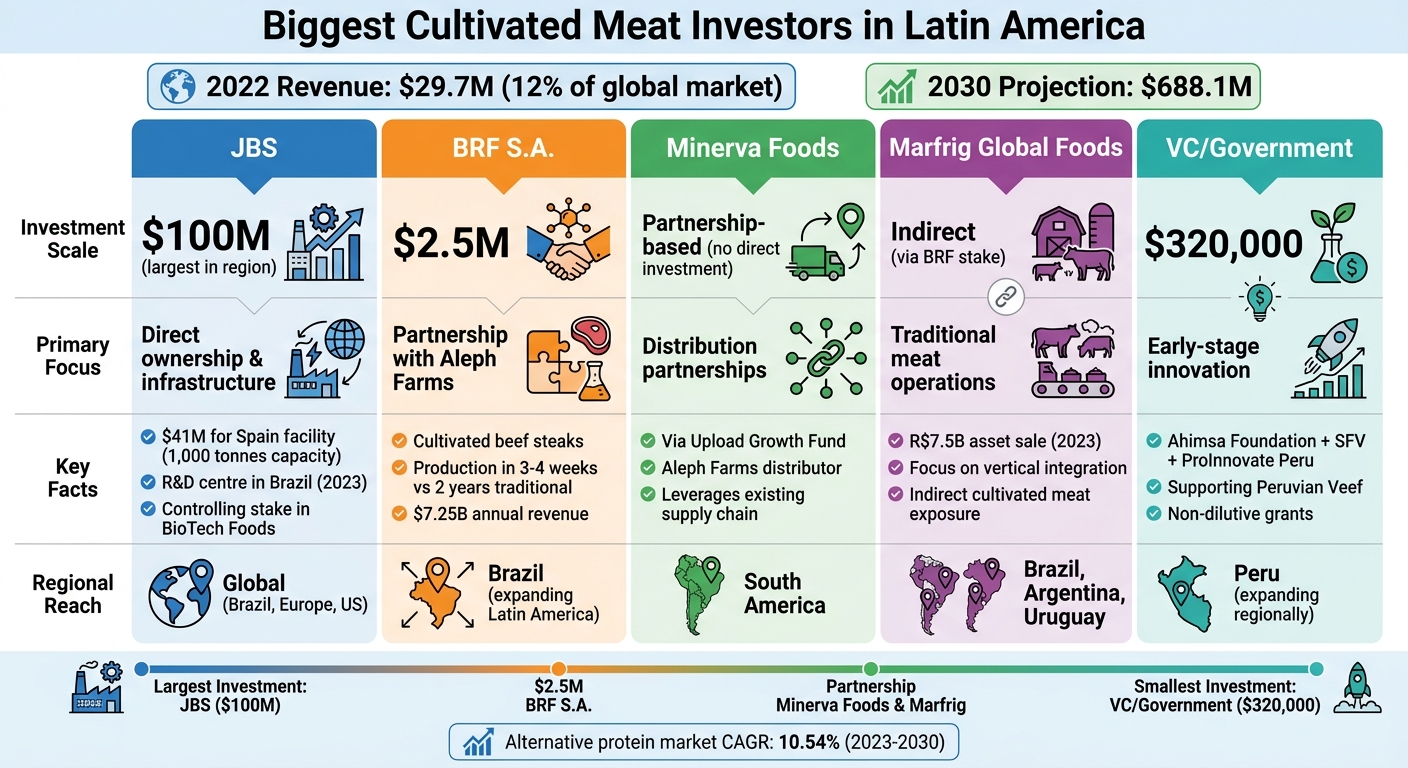
Major Cultivated Meat Investors in Latin America: Investment Scale and Strategy Comparison
1. JBS
Investment Scale
JBS has made a bold move into the cultivated meat sector with a massive $100 million (£79 million) investment, which stands out as the largest single investment in this industry by a Latin American company [2]. To put this into perspective, its regional competitor BRF invested a comparatively modest $2.5 million (£2 million) for a minority stake in Aleph Farms, an Israeli startup [3]. Out of JBS's total investment, $41 million (£32 million) has been earmarked for building a manufacturing facility in Spain, which will have an initial production capacity of 1,000 tonnes annually [2].
Primary Focus
JBS is taking a different approach compared to other major meat processors. While many companies opt for minority stakes in startups, JBS is pursuing majority ownership and direct investment in infrastructure. In November 2021, the company acquired a controlling stake in BioTech Foods, a Spanish cultivated meat firm, giving it direct access to advanced production technology [2]. As JBS Global CEO Gilberto Tomazoni stated:
When we enter a business, it is to have a leadership position [2].
This ambition underpins the company's strategy to lead in the cultivated meat space.
Regional Reach
JBS is using its investments to expand its global presence while focusing on Latin America. Although its production facility is based in Spain, the company has started construction on a dedicated R&D centre in Florianópolis, Brazil, as of September 2023 [3]. This move positions JBS to adapt cultivated meat technology specifically for Latin American markets, leveraging its role as the world's largest meat processor.
Strategic Motivations
JBS's strategy reflects its aim to diversify beyond traditional proteins. By integrating international technology with regional operations, the company is setting itself up to manage the entire supply chain - from research to production and distribution [3]. This approach aligns with its broader push into alternative proteins, which has included acquisitions like Vivera for €341 million (£286 million) in 2021 and The Vegetarian Butcher from Unilever in March 2025 [2][3]. These moves highlight JBS's commitment to reshaping its portfolio for the future.
sbb-itb-c323ed3
2. BRF S.A.
Investment Scale
BRF S.A. has taken a calculated step into the cultivated meat sector, investing $2.5 million (£2 million) in the Israeli startup Aleph Farms. This was part of a larger $105 million (£83 million) funding round in July 2021. Unlike some competitors, BRF's involvement reflects a more measured approach, focusing on a specific partnership rather than spreading investments widely. This move followed a memorandum of understanding signed in March 2021, which established BRF as a partner in co-developing and distributing cultivated beef in Brazil [4].
Primary Focus
With its investment in Aleph Farms, BRF has narrowed its focus to cultivated beef steaks. Instead of diversifying its portfolio, the company has chosen to concentrate on this specific product, utilising Aleph Farms' BioFarm platform. This platform employs non-GMO cell lines and avoids using fetal bovine serum, enabling the production of cultivated meat in just three to four weeks - dramatically faster than the roughly two years required for traditional cattle farming [4]. This efficiency highlights the key differences when comparing cultivated and traditional meat in terms of production speed and resource use. As Sergio Pinto, BRF's Director of Innovation, explained:
We are a food company that invests in advanced technology and respects and combines new trends associated with social and environmental sustainability. By producing high-quality sustainable cultivated meat, we can further establish our role as agents of transformation in the food industry. [4]
Regional Reach
BRF is leveraging its substantial revenue - approximately $7.25 billion (£5.7 billion) - and its portfolio of over 30 brands to initially focus on Brazil. As the world's largest beef exporter, responsible for 20% of global exports, Brazil represents a key market for BRF's cultivated beef initiatives. The company also plans to expand its offerings across Latin America. To support this endeavour, BRF is actively collaborating with Brazilian regulatory bodies, including the Ministry of Agriculture (MAPA) and ANVISA, to help shape the regulatory framework needed for cultivated meat approval [4].
Strategic Motivations
BRF views cultivated meat as a cornerstone of its strategy to diversify protein offerings, tackle environmental issues like deforestation in the Amazon, and align its growth with sustainability goals. Reflecting on the company's ambitions, CEO Lorival Luz stated:
BRF is poised to lead in this food revolution and be an active participant in one of the greatest industry transformations of this generation. [3]
This initiative complements the company's existing plant-based brand, Sadia Veg & Tal, creating a comprehensive portfolio that spans traditional meat, plant-based options, and cultivated meat. By doing so, BRF addresses both consumer demands and the pressing sustainability challenges that are reshaping the food industry in Latin America.
3. Minerva Foods
Investment Scale
Minerva Foods takes a different approach compared to JBS and BRF, focusing on partnerships rather than direct investments in cultivated meat startups. The company channels its investments through the Upload Growth Fund, sidestepping direct equity stakes. This fund, managed by Upload Ventures and anchored by TIM Brasil, includes institutional investors from Brazil and the United States. Minerva Foods uses this collaboration to enhance its value chain with B2B technology solutions aimed at improving competitiveness and productivity across its operations [5].
Primary Focus
Rather than developing technology in-house, Minerva Foods has partnered with Israeli startup Aleph Farms as a distributor. This collaboration allows Minerva to utilise its established market presence across South America to introduce cultivated meat products.
Regional Reach
As a leading beef exporter, Minerva Foods relies on its vast distribution network and strong retail partnerships to connect cultivated meat producers with Latin American consumers. Instead of investing in proprietary technology, the company focuses on using its well-established supply chain to bring cultivated meat to market.
Strategic Motivations
For Minerva Foods, alternative proteins represent a chance to tap into new markets and customer demographics while addressing sustainability challenges compared to beef. By focusing on its core strengths in food production and distribution, the company positions itself to benefit as the cultivated meat market grows. This strategy highlights the diverse approaches Latin American investors are taking to capture opportunities in this evolving sector.
4. Marfrig Global Foods
Marfrig Global Foods takes a different approach compared to JBS, BRF, and Minerva Foods, prioritising vertical integration to tighten its grip on production control.
Investment Scale
Instead of directly investing in cultivated meat, Marfrig focuses on strengthening its traditional operations. In August 2023, the company sold 16 cattle and sheep slaughter units spread across Brazil, Argentina, Uruguay, and Chile to Minerva Foods for R$7.5 billion. A portion of the proceeds - between R$1.5 billion and R$2 billion - was reinvested into its cattle operations [6].
Primary Focus
Marfrig is working to expand its on-farm cattle production, aiming to increase stability and consistency in its products. By 2025, it plans to raise on-farm production from 10% to 25%, with a target of processing 8,400 animals daily. This plan aligns with its U.S. subsidiary, National Beef, which already operates at this level. As Marcos Molina, the controlling shareholder, explained:
With your own slaughter, you can have greater control of the production chain than when you just use the spot market. National Beef... manages to have more stability and quality in the product [6].
Regional Reach
Following its 2023 divestments, Marfrig now operates 11 slaughter units across Brazil, Argentina, and Uruguay. The company is also pushing for 100% traceability of all cattle processed within its operating biomes by 2025. This move is aimed at unlocking access to additional international markets. Molina highlighted the benefits of this initiative:
This could also help Brazil to open up many more markets, like Uruguay, which has complete traceability and now has 15 more markets than Brazil [6].
Strategic Motivations
Although Marfrig hasn’t ventured directly into cultivated meat technology, its focus on production stability complements the broader shift in the industry. This transition is detailed in our roadmap for cultivated meat. The company also indirectly connects to cultivated meat through its controlling stake in BRF. For now, its key priorities include reducing plant idleness and achieving over 90% utilisation rates. This strategy allows Marfrig to remain competitive in a changing market while maintaining its operational efficiency.
5. Government and Venture Capital Investors (Ahimsa Foundation, Sustainable Food Ventures, ProInnovate Peru)
Venture capital firms and government agencies are playing a key role in shaping Latin America's alternative protein sector. While their focus isn't solely on cultivated meat, their investments in the broader food-tech ecosystem provide the groundwork that directly supports the development of cultivated meat technologies.
Investment Scale
In 2023/2024, Ahimsa Foundation, Sustainable Food Ventures, and ProInnovate Peru joined forces to support Peruvian cultivated meat startup Peruvian Veef, raising $320,000 (around £256,000). Ahimsa Foundation took the lead, bringing its expertise from working with global food-tech innovators. Sustainable Food Ventures, headed by Ryan Bethencourt, came on board as a co-investor, while ProInnovate Peru contributed a non-dilutive grant through the Startup Peru competition [7].
Primary Focus
The key priorities for these investors are sustainability and food security. Agriculture is responsible for over 58% of Latin America's greenhouse gas emissions, and global food demand is expected to rise by 80% by 2050 [8]. With the Latin American alternative protein market predicted to grow at a compound annual growth rate (CAGR) of 10.54% from 2023 to 2030, early-stage investors have a unique chance to tap into this expanding market [7]. Linda Obregon, Co-founder and CSO of Peruvian Veef, shared:
We are thrilled to have Ahimsa Foundation leading this round of investment. Their expertise and track record in the industry align perfectly with our vision to create sustainable and impactful solutions for the food industry [7].
Regional Reach
Ahimsa Foundation and Sustainable Food Ventures are US-based venture capital firms with global portfolios. They have previously supported cultivated meat trailblazers like Upside Foods (formerly Memphis Meats) and Finless Foods. Meanwhile, ProInnovate Peru focuses on domestic innovation, offering initial funding to Peruvian startups to help them develop proprietary technologies. These startups often expand into other Latin American countries such as Chile, Colombia, and Mexico [7]. Together, these investors bring both international and local expertise to strengthen the region's cultivated meat ecosystem.
Strategic Motivations
The collaboration between private venture capital and government funding creates a dynamic model for accelerating food-tech innovation in the region. Venture capital firms aim for scalability and market transformation, while government grants like those from ProInnovate Peru focus on stimulating local economic growth and reducing reliance on imports. This combined approach is laying the groundwork for future cultivated meat ventures by fostering expertise, building infrastructure, and increasing market awareness across Latin America [7].
Comparison of Investor Approaches
Latin America's cultivated meat sector showcases a variety of investment strategies, each tailored to specific goals and strengths. Established players like JBS and BRF S.A. leverage their infrastructure and networks to dominate a changing market, while venture capital and government initiatives focus on smaller-scale innovation.
Financial Commitments
The scale of financial commitment varies significantly across investors. For instance, JBS has taken a stake in Spain's BioTech Foods and started building a dedicated R&D centre for cultivated meat in Brazil as of September 2023, although the exact investment figures remain undisclosed [3]. On the other hand, BRF S.A. has opted for a strategic partnership model, exemplified by its US$2.5 million investment in Aleph Farms. In contrast, venture capital and government support for Peruvian startup Veef raised a comparatively modest US$320,000 (around £256,000), highlighting the stark difference between corporate and early-stage funding levels [7].
Strategic Approaches
The strategies adopted by these investors also differ significantly. JBS focuses on direct ownership and invests heavily in infrastructure to secure its position in the global market. BRF S.A., however, prefers forming partnerships to bring foreign innovations into Brazil. As BRF CEO Lorival Luz expressed:
BRF is ready and charged to play a leading role in this food revolution and be an active participant in one of the greatest industry transformations and economic breakthroughs of this generation [3].
Meanwhile, venture capital and government funding prioritise early-stage innovation, with initiatives like Peru's ProInnovate programme aimed at fostering domestic technological advancements within the broader field of cellular agriculture and cultivated meat [7].
Comparative Overview
| Investor | Investment Scale | Primary Focus | Regional Coverage | Core Motivation |
|---|---|---|---|---|
| JBS | Large (undisclosed) | Infrastructure development and BioTech Foods stake | Global (Brazil, Europe, US) | Market leadership and R&D advancement [3] |
| BRF S.A. | Moderate (US$2.5 million) | Partnership with Aleph Farms | Brazil | Leading industry transformation [3] |
| Marfrig | Indirect involvement | Traditional operations with indirect BRF connection | Americas (Brazil, US, Canada) | Stability and vertical integration [6] |
| VC/Government | Small (US$320,000/£256,000) | Support for early-stage startups | Peru | Promoting domestic innovation [7] |
Regional Focus
JBS operates globally, with a presence in Brazil, Europe, and the United States, while BRF S.A. focuses primarily on the Brazilian market [3]. In contrast, venture capital and government initiatives target domestic growth by supporting startups in countries like Peru [7].
These contrasting approaches highlight how established corporations and early-stage investors align their strategies with local and global market needs. Together, they shape the evolving landscape of cultivated meat investments in Latin America, setting the stage for future developments in this emerging industry.
Conclusion
Latin America's Cultivated Meat industry is evolving through distinct levels of investment, with major contributors like JBS and BRF reshaping the region's approach. These companies have committed substantial resources to infrastructure and research, driving the sector forward [3].
In 2022, the region generated US$29.7 million (£23.5 million) in Cultivated Meat revenue, accounting for 12.0% of the global market. Global industry momentum suggests this figure could climb to US$688.1 million (£545 million) by 2030 [1]. This remarkable growth highlights a shift in how investments are being channelled across Latin America.
Unlike other regions, the industry here is largely led by established meat producers looking to expand their protein offerings [3]. By collaborating with biotech firms from Israel and Europe, companies like JBS and BRF are adopting tried-and-tested technologies instead of building them from the ground up.
With strong infrastructure and international partnerships in place, the region is well-positioned for rapid market expansion once regulatory approvals are secured. By making use of established distribution networks, local research facilities, and strategic alliances, Latin America is gearing up to become a competitive force in the global Cultivated Meat market [1] [3].
FAQs
Why is Latin America investing heavily in cultivated meat now?
Latin America is focusing heavily on investment in cultivated meat, driven by a strong commitment to advancing sustainable food solutions. This effort also addresses concerns about the environmental impact of traditional meat production. The region has become a hub for emerging startups that are working towards shaping a more sustainable future for food.
How do investor strategies differ between JBS, BRF, and Minerva Foods?
Investor strategies for cultivated meat show distinct approaches among JBS, BRF, and Minerva Foods.
JBS has gone all in, committing a hefty $100 million to acquire a cultivated meat company and establish supporting infrastructure. Meanwhile, BRF has opted for a more measured path, looking into both cultivated and plant-based alternatives but steering clear of direct acquisitions. On the other hand, Minerva Foods seems to be in the early stages, with no significant public investments or acquisitions in the cultivated meat space so far.
What needs to happen for cultivated meat to be sold widely in Latin America?
For cultivated meat to become accessible across Latin America, several pieces of the puzzle need to come together. One of the biggest priorities is boosting investment, both from private companies and government initiatives. Equally important is creating regulatory frameworks that can facilitate the approval of these products, ensuring they meet safety and quality standards.
Another critical aspect is consumer education. People need to understand what cultivated meat is, how it’s made, and why it can be a viable alternative. This will help build trust and spark interest. At the same time, challenges like scaling up production and cutting costs must be tackled to make these products affordable and widely available throughout the region.


