

Your meat choices can impact biodiversity more than you might think. Conventional meat production is a leading cause of habitat destruction, greenhouse gas emissions, and water pollution, all of which harm ecosystems. By switching to alternatives like Cultivated Meat - grown from animal cells without large-scale farming - you can help reduce land use, deforestation, and emissions while protecting wildlife.
Key points to know:
- Land Use: Livestock farming takes up 77% of agricultural land but provides only 18% of global calories. Cultivated Meat requires up to 99% less land.
- Emissions: Livestock accounts for 14–18% of global greenhouse gas emissions, including 32% of methane emissions. Cultivated Meat eliminates methane entirely.
- Pollution: Fertiliser runoff and manure from conventional farming degrade water systems, while Cultivated Meat reduces phosphorus pollution by 53%.
- Global Impact: Deforestation for feed crops, especially in biodiversity hotspots like the Amazon, threatens species. Cultivated Meat reduces reliance on these crops.
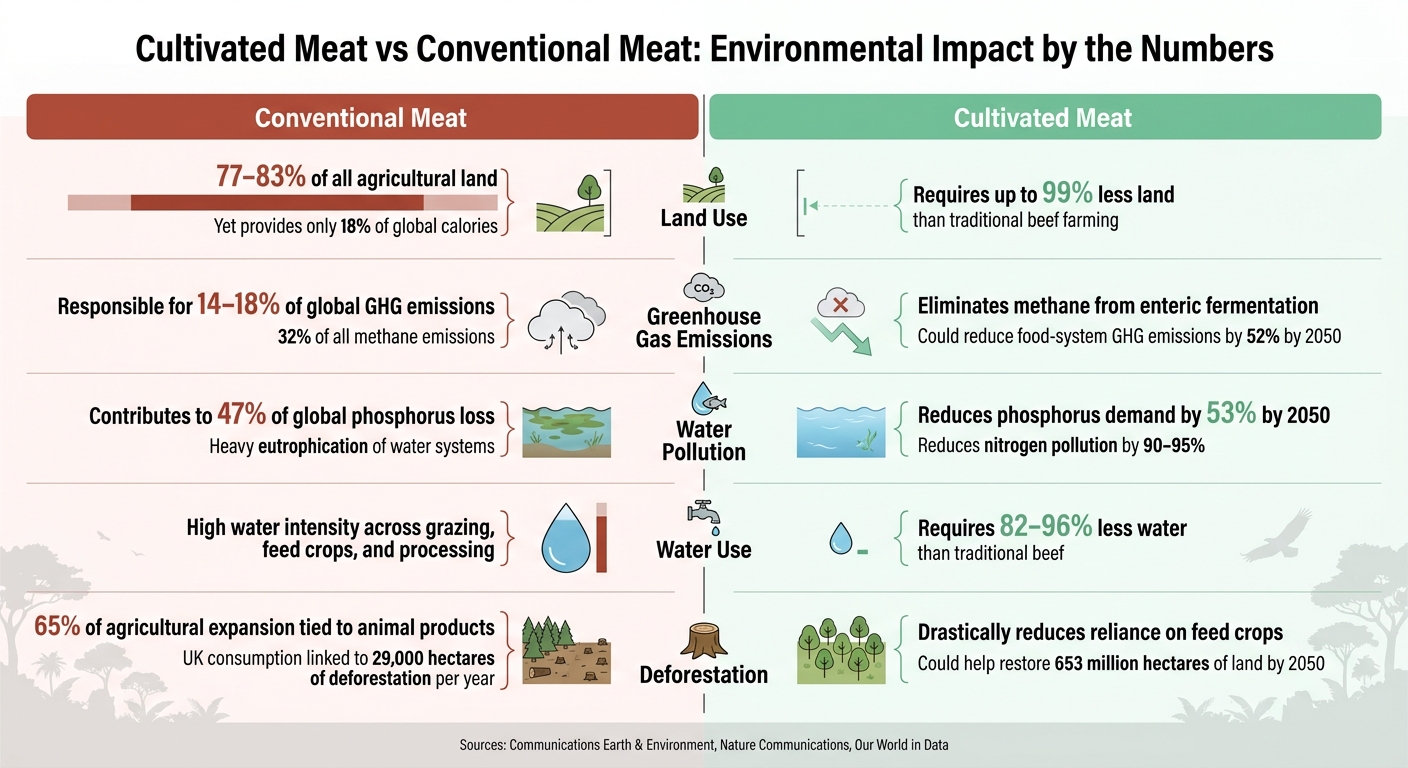
Cultivated Meat vs Conventional Meat: Environmental Impact by the Numbers
Meat Production and Land Use
How Does Conventional Meat Production Use Land?
Meeting the global demand for meat requires a staggering amount of land. Currently, agriculture takes up about 50% of the world's habitable land. Of that, livestock - including grazing areas and the crops grown to feed animals - accounts for a massive 77–83% of all agricultural land. Yet, despite this vast land use, meat and dairy contribute only 18% of the world's calories and 37% of its protein supply [4][5].
The environmental cost of this land use is steep. To create space for grazing and feed crops, forests, grasslands, and wetlands are frequently cleared, leading to significant biodiversity loss. Today, farmed livestock outweigh wild mammals by an astonishing factor of 15 to 1 [4]. As highlighted by Our World in Data:
"This loss of natural habitat has been the main driver for reducing the world's biodiversity. Wildlife can rebound if we reduce agricultural land use and allow natural lands to restore." [4]
This heavy reliance on land underscores the stark difference in space requirements between conventional meat production and Cultivated Meat.
Land Use Compared: Cultivated Meat vs Conventional Meat
Cultivated Meat offers a radically different approach. By growing meat directly from animal cells in controlled environments, it eliminates the need for grazing lands and large-scale feed crop farming. The result? A dramatically smaller land footprint. For instance, precision fermentation milk can use up to 96% less land compared to traditional cow's milk [5].
Studies suggest that replacing 50% of global animal products with alternative proteins could shrink the global agricultural area by around 12% by 2050. This would free up approximately 653 million hectares of land, creating opportunities for rewilding [7].
"Reducing animal agriculture is key to releasing land needed to achieve global environmental goals." - Jade A. Warren, Centre for Environmental Policy, Imperial College London [5]
These global shifts also have important implications for countries like the UK.
UK Meat Consumption and Its Effect on Land and Biodiversity
In the UK, agriculture dominates 69% of the land, with livestock production accounting for about 85% of that. This includes 75% of agricultural land used for grazing and 25% for growing feed crops [5]. Such extensive use leaves little room for natural ecosystems and puts pressure on habitats vital for native wildlife.
The UK's impact, however, extends beyond its borders. In 2023, UK consumption of crops, cattle-related products, and timber was linked to an estimated 29,000 hectares of deforestation worldwide [6]. Much of this deforestation occurs in Central and South America - regions home to some of the planet's most vulnerable species. By shifting towards Cultivated Meat, the UK could significantly reduce its overseas footprint and help protect these biodiversity hotspots.
sbb-itb-c323ed3
Emissions, Pollution, and Biodiversity Loss
How Greenhouse Gas Emissions from Livestock Affect Biodiversity
Conventional meat production doesn’t just harm biodiversity through land use; it also contributes significantly to climate change by emitting greenhouse gases (GHGs) like methane and nitrous oxide. These emissions accelerate global warming and disrupt ecosystems, impacting species far beyond farming regions.
Globally, the food system accounts for 21–37% of all human-caused GHG emissions [1], with livestock production alone responsible for 14–18% of global emissions, including a staggering 32% of all methane emissions [9]. Methane, a particularly potent greenhouse gas, traps heat far more effectively than CO₂. Ruminants such as cattle, sheep, and goats are the main culprits, producing about 80% of livestock-related methane through a digestive process called enteric fermentation [9].
"Methane emissions are responsible for 70% of the overall greenhouse gas-driven biodiversity footprint [of food]." - Nature Communications [1]
As temperatures rise, ecosystems are thrown off balance. Species with limited geographic ranges, often in the planet’s most biodiverse areas, are especially at risk. A study in Nature Communications forecasts that by 2070, climate change could rival or even surpass land use as the leading cause of biodiversity loss [1]. Unlike deforestation, which impacts specific areas, climate-driven biodiversity loss is a global issue, affecting ecosystems regardless of where emissions originate. Compounding the problem, conventional meat production also pollutes water systems, further harming biodiversity.
Water Pollution from Conventional Meat Production
Beyond emissions, conventional meat production significantly degrades water quality. The heavy use of nitrogen and phosphorus fertilisers for growing animal feed, combined with manure runoff, leads to eutrophication. This process creates oxygen-depleted zones in rivers, lakes, and coastal waters where aquatic life struggles to survive.
Agricultural runoff and livestock waste contribute to 47% of global phosphorus loss [2]. High-intensity pasture management worsens the situation, leading to concentrated nutrient deposits that research describes as being "harmful to most organisms" [8]. This has left up to half of the world’s grasslands in a degraded state.
How Cultivated Meat Could Cut Emissions and Pollution
Cultivated Meat offers a promising alternative by tackling these issues at their root. Instead of raising animals, cultivated meat grows meat directly from animal cells in a controlled environment, eliminating methane emissions caused by enteric fermentation. A full shift to Cultivated Meat could reduce food-system GHG emissions by 52% and cut phosphorus demand by 53% by 2050.
"Transition to cellular agriculture by 2050 could reduce annual greenhouse gas emissions by 52%, compared to current agriculture emissions, reduce demand for phosphorus by 53%, and use 83% less land than traditional agriculture." - Communications Earth & Environment [2]
However, the environmental benefits of Cultivated Meat hinge on using renewable energy for production. The process is energy-intensive, and relying on fossil fuels would undermine its potential to reduce emissions. Fortunately, projections suggest that by 2050, green energy could account for two-thirds of global energy production [2]. This shift would make Cultivated Meat an even more effective solution for reducing emissions, nutrient runoff, and land use, while also aiding in biodiversity recovery. By easing the strain on natural habitats, it could play a crucial role in reversing biodiversity decline.
Global Biodiversity Hotspots and Meat Choices
What Are Biodiversity Hotspots and Why Do They Matter?
Biodiversity hotspots are regions teeming with unique, often endemic species that aren’t found anywhere else in the world [1]. These areas are usually concentrated in tropical zones, where ecosystems are highly sensitive to environmental changes like land-use shifts and climate fluctuations. Many species in these regions occupy very limited habitats, meaning the loss of their environment can push them dangerously close to extinction [1].
Beyond their incredible diversity, these hotspots provide essential services that benefit the entire planet. They store large amounts of carbon, help regulate water cycles, and maintain ecological balance far beyond their borders. Losing these areas would disrupt these critical functions, with far-reaching consequences.
How Imported Feed Crops Drive Biodiversity Loss
The demand for global feed crops is putting even more pressure on these fragile ecosystems. For instance, beef production in the UK has direct links to deforestation in other parts of the world. Over the past few decades, 65% of agricultural expansion has been tied to the production of animal products [10].
Take Brazil as an example. The country’s cattle ranching and soy production for livestock feed have transformed vast areas of the Amazon and Cerrado into farmland. Brazil is home to the highest number of endemic species globally, making this land conversion especially harmful to biodiversity [11]. Unlike the Amazon, the Cerrado has weaker legal protections, allowing soy farming to expand with little restriction [11].
"Converting forests, savannas, and grasslands into pasture or cropland for animal feed fragments habitat, reduces carbon storage, and pushes species toward extinction." - Stanford Woods Institute [9]
This issue isn’t confined to Brazil. Across the globe, enormous swathes of agricultural land are dedicated to feeding livestock, highlighting the unsustainable nature of animal-based feed production [9][3].
How Cultivated Meat Could Reduce Pressure on Hotspots
Cutting down on feed crop demand could significantly ease the strain on these critical regions, and that’s where Cultivated Meat comes in. By growing meat directly from animal cells, this method bypasses the need for large-scale feed-crop monocultures. Studies estimate that Cultivated Meat could reduce land use by up to 99% compared to traditional beef farming [3], providing much-needed relief to areas like the Amazon and Cerrado.
What’s more, the land freed up by reducing conventional agriculture could be used for ecological restoration. Rehabilitating former farmland in forest ecosystems could help meet 13–25% of the global land restoration goals set by the Kunming-Montreal Global Biodiversity Framework for 2030 [7].
The benefits of Cultivated Meat extend far beyond its production sites. Unlike conventional meat, which often causes environmental harm where it’s produced, Cultivated Meat’s minimal land footprint can help protect biodiversity hotspots thousands of miles away - even benefiting ecosystems tied to UK consumers. This makes it an appealing choice for those in the UK who want to make biodiversity-friendly food decisions.
Steps UK Consumers Can Take to Support Biodiversity
Small Food Choices That Can Make a Difference
You don’t need to completely overhaul your diet to make a positive impact. Small, thoughtful changes can go a long way.
One simple step is reducing food waste, which has a huge effect on biodiversity. In fact, studies show that cutting food waste in half could deliver over half the biodiversity benefit of switching entirely to a sustainable diet [13]. By planning meals and keeping your fridge organised, you can achieve results comparable to much larger dietary changes.
Another impactful choice is rethinking the type of meat you eat. Beef has the highest environmental toll, producing between 27 and 60 kg of CO₂-equivalent per kilogram, compared to around 6 kg for poultry [12]. Even swapping beef for chicken or pork a few times a week can significantly lower your carbon footprint and help reduce methane emissions.
For those who still enjoy meat, exploring alternatives like Cultivated Meat offers another way to make a difference.
Where Cultivated Meat Fits in a Biodiversity-Friendly Diet
Beyond reducing food waste, reconsidering the source of your meat can further support biodiversity. Cultivated Meat, grown from animal cells in controlled environments, offers a way to enjoy meat with far less environmental impact. This method avoids the land-intensive feed crops and methane emissions tied to traditional livestock farming, which are major drivers of biodiversity loss.
Blended products are a practical starting point. These combine a small amount of Cultivated Meat with conventional meat, offering a familiar taste while cutting environmental costs. For example, Ivy Farm Technologies, based in Oxford, is seeking regulatory approval in the UK for such products. As their CEO, Dr. Harsh Amin, explains:
"If you want to make a sustainable difference, you have to go for mass production and burgers are where the masses are. If you blend our cultivated meat with animal derived meat, you are [still] reducing the carbon footprint." [14]
If you’re curious about what’s next for this technology, the Cultivated Meat Shop provides updates on regulatory progress, product previews, and other developments in the UK.
What Cultivated Meat Could Mean for Biodiversity Long Term
For UK consumers, embracing Cultivated Meat could reshape biodiversity outcomes both locally and globally. As production scales up, it has the potential to transform how meat consumption impacts land use. Research indicates that replacing conventional beef farming with Cultivated Meat could significantly reduce the land required for agriculture, opening up opportunities to restore natural habitats and combat biodiversity loss.
Dr. John Lynch of Oxford University highlights the specific benefits of Cultivated Meat for beef:
"For beef, it is quite viable for cultured meat to come out on top [in terms of climate impact]." [14]
Currently, UK food consumption drives an estimated 29,000 hectares of agriculture-related deforestation globally each year [6]. By shifting to Cultivated Meat, even in the form of blended products, consumers can help protect biodiversity hotspots that are under increasing threat.
Can Lab-Grown Meat Save the Planet?
Conclusion: Making Meat Choices That Are Better for Biodiversity
Conventional meat production places immense pressure on the environment. Livestock farming takes up a staggering 77% of global agricultural land while contributing only 20% of the world’s calorie supply [15]. This imbalance fuels habitat destruction, pollutes water sources, and generates greenhouse gases - all of which threaten biodiversity.
Cultivated Meat offers a completely different path. It can be produced using up to 95% less land than traditional beef, requires 82–96% less water, and could reduce nitrogen pollution by as much as 90–95% [15]. The land spared from livestock farming could be transformed into wildlife corridors, rewilded spaces, or carbon sinks, benefiting countless species and ecosystems. These numbers highlight the potential for Cultivated Meat to reshape food production in a way that works with nature instead of against it.
"This isn't about making small, incremental improvements to conventional systems. Cultivated Meat offers a paradigm shift in how we produce protein - one that aligns technological innovation with environmental stewardship." - Cultivated Meat Shop [15]
Even small steps can help ease the strain on ecosystems. Actions like eating less beef, reducing food waste, or opting for blended alternatives can all make a difference. However, Cultivated Meat represents the most impactful change we can embrace. By making these choices, we don’t just protect biodiversity - we take meaningful steps toward a sustainable future.
To stay informed about developments in this field in the UK, visit Cultivated Meat Shop.
FAQs
How does eating less beef help biodiversity?
Reducing beef consumption lowers the demand for land and water tied to cattle ranching and feed crop production. Traditional beef farming contributes to habitat destruction, deforestation, and fragmented ecosystems, threatening numerous species. By eating less beef, you play a role in safeguarding forests, wetlands, and grasslands. Cultivated Meat Shop provides resources on how choosing Cultivated Meat - real meat grown from animal cells - can help preserve biodiversity and rejuvenate essential ecosystems.
Does Cultivated Meat still help the environment if it uses a lot of energy?
The environmental footprint of cultivated meat largely hinges on the energy powering its production. Unlike traditional livestock farming, it relies on industrial-scale energy to operate bioreactors. If renewable energy sources are used, cultivated meat has the potential to drastically cut emissions - outperforming beef and pork in this regard. However, when dependent on the current global energy mix, its emissions could surpass those of chicken or pork. For further insights into its sustainability, visit Cultivated Meat Shop.
How does UK meat consumption contribute to deforestation abroad?
The UK's appetite for meat has a hidden cost: deforestation in other parts of the world. This is largely driven by the need for imported cattle-based products and animal feed, such as soy. To meet this demand, forests in countries like Brazil are often cleared to make way for pastures or to grow feed crops. At Cultivated Meat Shop, we emphasise that switching to cultivated meat can be a game-changer. It offers a land-efficient alternative that eases the strain on global ecosystems and helps protect biodiversity.


