

Cultivated meat is becoming more affordable and efficient thanks to advanced cell growth technologies. Brands are reducing production time, cutting costs, and improving scalability, making lab-grown meat a viable alternative to conventional farming. Here's a quick look at the key advancements:
- Meatable: Reduced pork production time from 45 days to just 4 using "Opti-Ox" technology.
- Uncommon (formerly Higher Steaks): Uses RNA-based tech to mature cells in 3 days without gene editing.
- Aleph Farms: Simplified processes with single bioreactors, cutting differentiation time by 60%.
- Believer Meats: Achieved high cell densities and daily harvesting before ceasing operations in 2025.
- Steakholder Foods: Focuses on 3D bioprinting for structured cuts like steaks and fish fillets.
- IntegriCulture: Modular reactors and simplified designs for cost-effective, small-scale production.
Each company is tackling production challenges with unique strategies, from reducing growth media costs to optimising bioreactor designs. These developments are bringing cultivated meat closer to price parity with traditional options, offering a more resource-efficient way to produce meat.
Quick Comparison
| Brand | Key Tech/Methodology | Production Time | Cost Focus | Current Status |
|---|---|---|---|---|
| Meatable | Opti-Ox technology | 4 days | Media cost reduced by 100x | Ceased operations (2025) |
| Uncommon | RNA-based cell maturation | 3 days | Reduced protein use | Scaling production |
| Aleph Farms | Single bioreactor process | 4 weeks | £4.50–£5.25 per lb target | Expanding globally |
| Believer Meats | High-density suspension system | Not specified | £1.40 per chicken breast | Shut down (2025) |
| Steakholder | 3D bioprinting | Not specified | Licensing model | Active |
| IntegriCulture | Modular Oxy-thru Cultivators | 1 kg/month/unit | Simplified reactor design | Profitable as of 2025 |
These companies are setting the stage for cultivated meat to compete with conventional meat on price and availability.
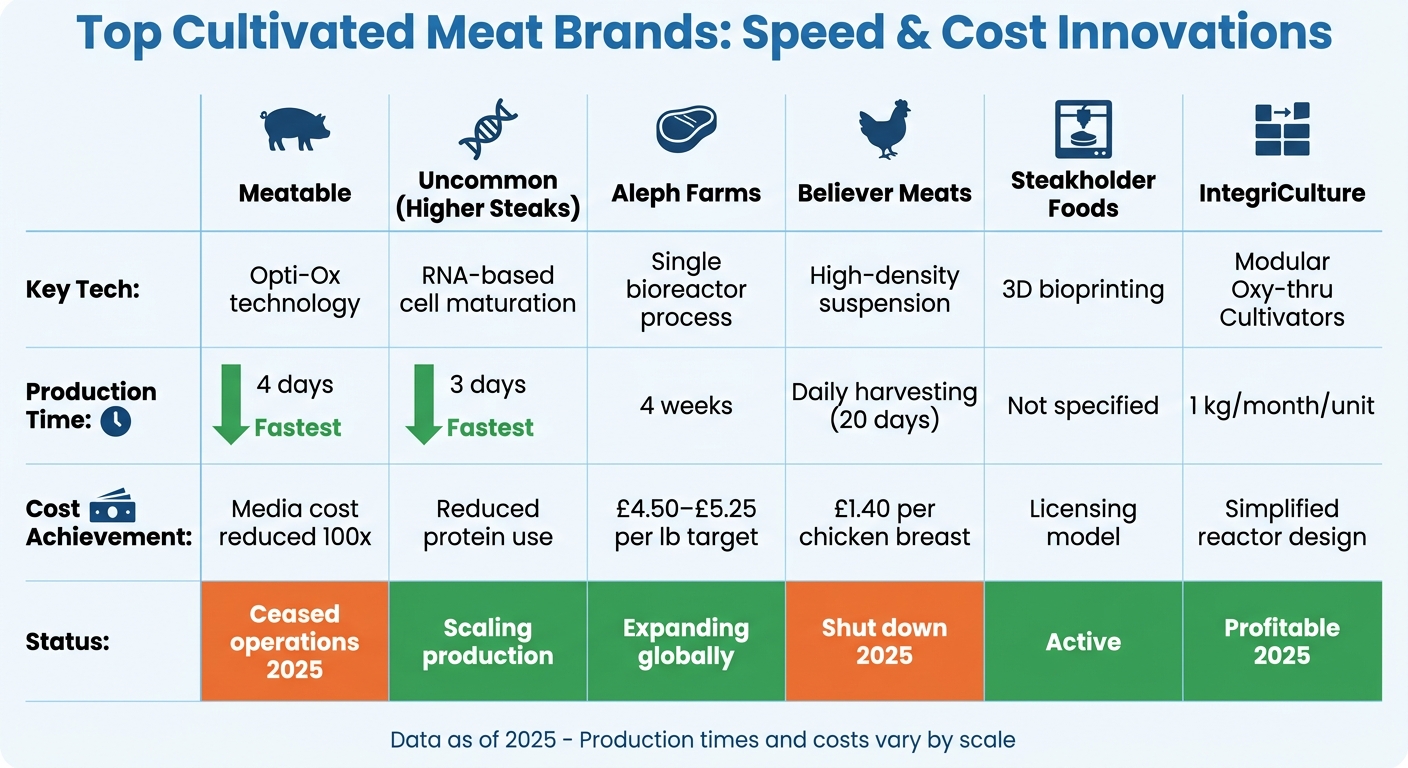
Cultivated Meat Brands: Production Speed and Cost Comparison 2025
1. Higher Steaks

Higher Steaks, now rebranded as Uncommon, is transforming how Cultivated Meat is produced. This UK-based company uses RNA molecules to guide cell behaviour, speeding up the process of turning stem cells into muscle tissue. Unlike traditional methods that depend on slower chemical signalling, their approach avoids altering the cells' genetic structure permanently[6].
Faster Cell Growth
Uncommon's RNA-based technology delivers impressive results. It can progress from pluripotent stem cells to mature muscle markers and multi-nucleation in just 3 days. Co-founder and CEO Benjamina Bollag highlighted this breakthrough:
"We can get from pluripotent stem cells to mature muscle markers and multi-nucleation in three days without using gene editing."[6]
By directly instructing cells via RNA, the process eliminates the need for gene editing, making it both quicker and highly efficient. This rapid maturation is a key advantage for scaling production.
Scaling Production
The speed of cell maturation plays a crucial role in scaling up production. In May 2023, Uncommon raised $30 million in Series A funding, with Balderton Capital and Lowercarbon Capital leading the round. The funding supports scaling efforts at their Cambridge Technopark facility, with plans to reach a 200-litre bioreactor capacity by the end of 2023[6][7].
For their initial market entry, the company is focusing on hybrid products that combine cultivated muscle and fat cells with plant-based components. This approach makes commercial production more feasible in the short term.
Cutting Costs
The RNA transfection process also helps reduce costs by lowering the need for expensive proteins in cell culture media. Faster cell growth means bioreactors can produce more meat in less time, reducing capital costs per kilogram. Bollag explained:
"By using RNA, we can move down the cost curve faster than our competition and without gene editing."[6]
Uncommon's goal is to initially match the price of organic meat, with a longer-term aim of competing with conventional meat prices[7].
sbb-itb-c323ed3
2. Believer (formerly Future Meat Technologies)
Believer Meats, previously known as Future Meat Technologies, was a trailblazer in the cultivated meat industry, developing one of the fastest cell growth systems before shutting down in December 2025. Though the company ceased operations, its advancements in rapid cell cultivation continue to influence the field, offering insights into how accelerated growth can reshape meat production.
Advances in Cell Growth
Believer's approach focused on spontaneously immortalised cells, which divided up to 10 times faster than the industry norm. This breakthrough allowed the company to achieve a biomass density of 130 billion cells per litre, enabling daily harvesting for 20 consecutive days [8][11]. Their high-density suspension culture system delivered a yield of 43% weight per volume, with cells thriving in an animal-free, serum-free medium. By incorporating tangential flow filtration technology, they managed to optimise media use, supporting sustained cell growth on an industrial scale [11].
Cutting Costs
In 2021, Believer made significant strides in reducing production costs. The price of a cultivated chicken breast dropped from around £6.00 to £1.40. Meanwhile, their animal-free culture medium was priced at approximately £0.50 per litre. At a 50,000-litre scale, this translated to a production cost of about £5.00 per pound of cultivated chicken [8][9][11]. Their continuous production process, paired with tangential flow filtration for media rejuvenation, maintained high cell densities and rapid growth while minimising the need for expensive media [9][11].
Scaling Up Production
Believer's technical innovations culminated in the construction of a 200,000-square-foot (roughly 18,600 m²) facility in Wilson County, North Carolina. This site was designed to produce 12,000 tonnes of cultivated chicken annually [11]. The company also achieved significant regulatory milestones. After receiving the FDA's "no questions" letter, which confirmed the safety of its products, Believer became the first non-US company to earn USDA label approval for cultivated meat in late 2025 [11].
"We've received the FDA's 'no questions' letter confirming the agency's acceptance of our safety conclusion. We've completed construction of our North Carolina facility, the first and only large-scale cultivated meat production site in the world." - CEO Gustavo Burger [9]
Despite these accomplishments, Believer faced funding difficulties and high operational costs, which ultimately led to its closure [8][10].
3. Aleph Farms
Aleph Farms has made strides in cultivated meat production with its "1.2" platform, which simplifies the growth process. The Israeli company has achieved a 60% reduction in differentiation time and slashed production costs by an impressive 97% since 2020 [16][17]. Thanks to these advancements, the production of an "Aleph Cut" now takes only about four weeks [12].
Cell Growth Speed Improvements
One of Aleph Farms' key innovations is its use of a single stirred-tank bioreactor for both cell proliferation and differentiation [16][17]. This eliminates the need for additional tissue bioreactors and traditional scaffolding. Instead of relying on scaffolding, the company grows cells in suspension as aggregates. These cells are then integrated into a proprietary plant-based matrix made from soy and wheat, ensuring uniform distribution [16][12].
"Our optimised process is streamlined, utilising a stirred-tank bioreactor for both proliferation and differentiation, enhancing efficiency whilst preserving product quality... It is also more efficient, reducing differentiation time by 60%." - Didier Toubia, CEO and Co-Founder, Aleph Farms [16]
Aleph Farms further enhances its efficiency by using advanced data analytics to refine its processes.
Technology Developments
These advancements in cell growth have paved the way for additional technological progress. Aleph Farms has partnered with BioRaptor to implement an AI operating system that processes vast amounts of data from bioreactors, such as pH levels, dissolved oxygen, and temperature [14]. This AI-driven system optimises experimental designs and ensures maximum utilisation of feed and growth media, achieving a zero-waste process [16]. For producing thicker cuts, Aleph Farms employs 3D-bioprinting to create a vascular-like system that enables nutrients to reach all parts of the tissue, closely mimicking natural growth [13].
Cost Reduction Strategies
Aleph Farms is targeting production costs of £10.50 per lb at medium-scale (2,000–5,000 litres) and £4.50–£5.25 per lb at large-scale production, with the potential to lower costs further to around £3.06 per lb [16][17][2]. These reductions are crucial for making cultivated meat more affordable and competitive with traditional meat production costs. To cut costs even more, Aleph Farms has collaborated with WACKER to develop a non-exclusive supply chain for food-grade growth medium proteins, replacing the costly fetal bovine serum [18].
Production Scalability
In 2022, Aleph Farms expanded into a 65,000-square-foot (approximately 6,040 m²) facility and adopted an asset-light hub-and-spoke model. By partnering with regional manufacturers like Cell Agritech, the company achieved a sixfold increase in operational capacity [13][19]. Aleph Farms also made history by receiving the world's first regulatory approval for cultivated beef in Israel in early 2024. The company has since applied for approval in Switzerland, the UK, and Thailand [13][15][16].
4. Meatable
A Dutch company, Meatable, achieved a major milestone by reducing the time needed to produce cultivated pork from 45 days to just four by March 2024. This makes their process about 60 times faster than conventional pig farming methods [1][20][21]. Meatable's CTO, Daan Luining, highlighted this achievement, saying:
"We went from 45 days to 21, then eight, and now four days... Doing it this fast is ultimately what makes our cultivated meat production process economically viable" [1].
Advancements in Cell Growth
The secret to Meatable's rapid production lies in its advanced technology. Their patented opti-ox technology plays a pivotal role, activating transcription factors that speed up cell differentiation. By using pluripotent stem cells sourced from animal umbilical cords, which double every 16–24 hours in a continuous perfusion process, Meatable achieves impressive results. The system allows for frequent harvesting of up to 100% of the bioreactor volume, reaching cell densities of 80 million cells per millilitre [1][20].
Cutting Costs
Reducing differentiation time from eight to four days has significant benefits. It nearly halves the number of bioreactors needed, cutting capital costs and making better use of available space [21]. Meatable also collaborated with Royal DSM to reduce the cost of key media nutrients by 100 times within a year [1]. While the company aims to use 10,000-litre bioreactors for profitable production, current operations are limited to smaller scales, ranging from 50 to 500 litres [1]. Despite these cost-cutting measures, scaling up production brought its own set of hurdles.
Challenges with Scaling
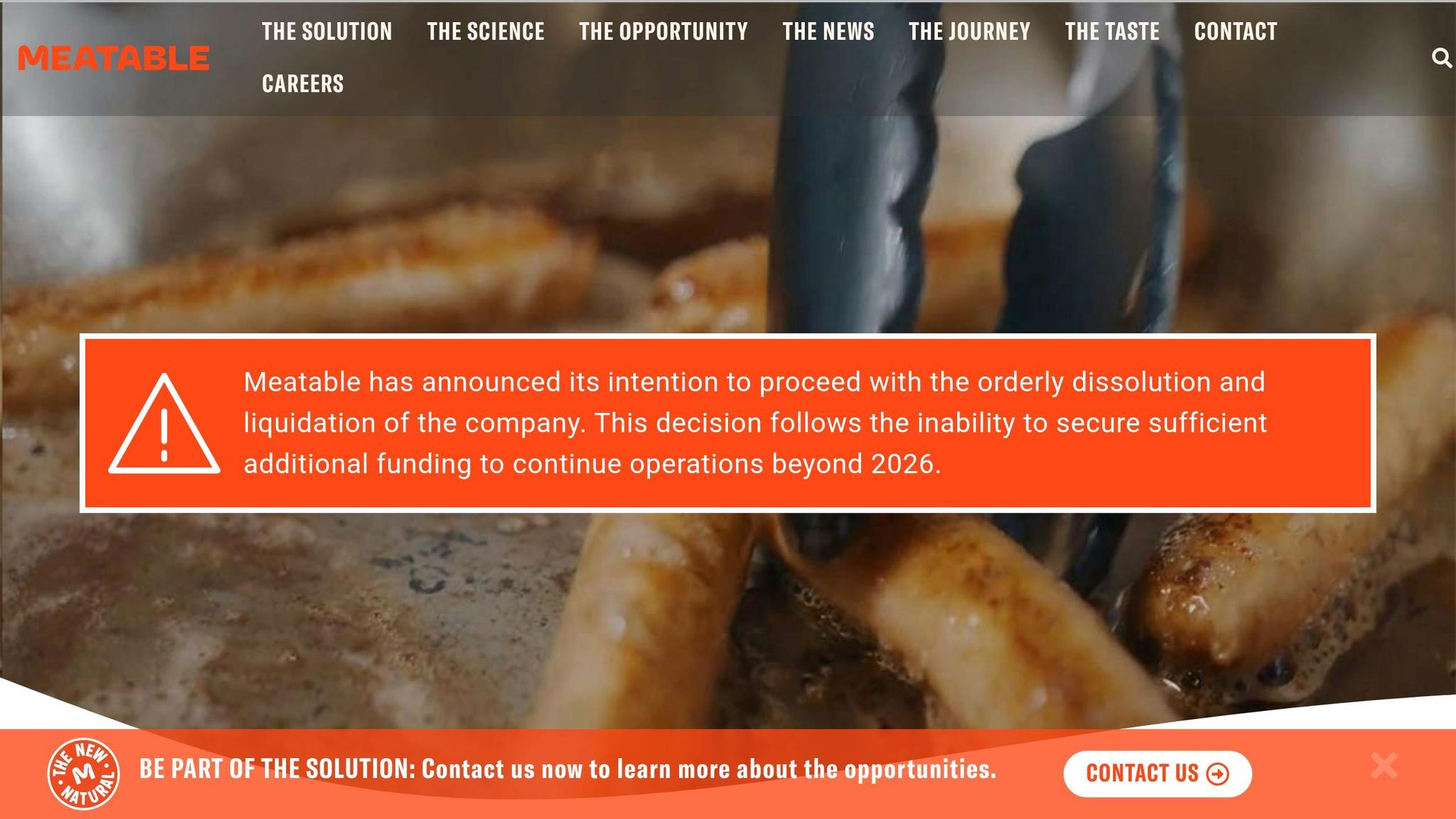
Even with its technological advancements, Meatable encountered financial difficulties. By September 2025, after raising approximately £80 million, the company ceased operations before it could launch its products in Singapore (2024) and the U.S. (2025) [1][20][21][22]. Although scaling proved problematic, Meatable's innovations in rapid cell growth have left a lasting impact, showcasing the potential of accelerated production methods to make cultivated meat economically feasible.
5. Steakholder Foods
Steakholder Foods uses 3D bioprinting technology to advance cultivated meat production on an industrial scale. Based in Israel, the company has introduced a "Ready-to-Print" (RTP) business model. This approach provides partners with industrial-grade 3D bioprinters and specially formulated bio-inks, enabling decentralised production. By doing so, Steakholder Foods simplifies the production process while addressing the industry's need for scalable and efficient solutions in cultivated meat.
Technology Developments
The company utilises Drop-on-Demand (DoD) printing, a method that precisely places cells and scaffolding materials to create structured cultivated meat products. This precision allows them to replicate traditional cuts, such as steaks and fish fillets, offering a product that closely resembles conventional meat. These technological advances are key to supporting sustainable growth in the cultivated meat sector.
Production Scalability
Scalability is achieved through modular printer designs that adapt to various production sites. Instead of building centralised facilities, Steakholder Foods licenses its technology to partners, significantly reducing the upfront costs of expansion. The RTP model supports horizontal scaling, where partners can start with smaller production volumes and add more printing units as demand increases. This flexible, modular approach aligns with growth strategies used by other leading brands, combining advanced technology with cost-effective production to meet market needs efficiently.
6. IntegriCulture
IntegriCulture, a forward-thinking Japanese company, takes a distinctive "scale-out" approach to Cultivated Meat production. Instead of relying on large, centralised bioreactors, they utilise smaller, modular units that work together to achieve commercial-scale production. This method not only lowers upfront costs but also minimises technical risks while maintaining impressive cell densities. In August 2025, IntegriCulture, in collaboration with Hamano Products Co., Ltd., introduced the Product Reactor at a facility in Fujisawa, Japan. This reactor employs a stirring packed-bed method to optimise production processes [23].
Technology Developments
A standout innovation from IntegriCulture is their Oxy-thru Cultivator, a cutting-edge bioreactor design. This 2-litre cultivator, constructed from materials with high gas permeability, delivers oxygen from both the base and the sides. This design achieves higher oxygen concentrations, leading to increased cell densities, all without requiring complicated external systems. Remarkably, each unit can produce around 1 kg of Cultivated Meat per month [24].
"Oxy-thru Cultivator is a packed-bed bioreactor... that makes a hybrid product in one go. From a bioprocess point of view, it is effectively 'cell culture in a bucket' that even the smallest institutions can implement." – Yuki Hanyu, Founder and CEO, IntegriCulture [24]
These advancements not only improve production efficiency but also pave the way for making Cultivated Meat more affordable.
Cost Reduction Strategies
By simplifying the design of their systems, IntegriCulture has significantly reduced capital costs. According to CEO Yuki Hanyu, "Cell harvest is just by decanting", which further simplifies operations [24]. Thanks to these cost-saving measures, the company achieved profitability for the first time in 2025, earning approximately £240,000 in profit from sales totalling about £1.2 million [24].
Production Scalability
With costs under control, IntegriCulture is now focusing on scaling up production globally. In March 2026, the company partnered with Sumitomo Riko and Malaysian contract manufacturer Cell AgriTech to demonstrate avian cell production in Singapore. This initiative uses the Oxy-thru Cultivator to validate large-scale production and supports a regulatory application to the Singapore Food Agency by the end of 2026 [24]. This move underscores how their modular technology can be adapted to various markets without requiring massive centralised facilities, making global expansion more feasible.
Brand Comparison Table
The table below highlights how leading Cultivated Meat brands are advancing production through diverse growth media strategies, bioreactor innovations, production timelines, and cost considerations.
| Brand | Growth Media Strategy | Bioreactor Technology | Production Timeline | Cost Metrics |
|---|---|---|---|---|
| Higher Steaks | Not specified | Automated bioprocessing for pork products | Not publicly disclosed | Focus on reducing costs and energy usage [4] through nutrient recovery |
| Believer Meats | Non-GMO technology for efficient media use | High-density cell culture systems | Not specified | £1.35 per 110g chicken breast (2021) [5] |
| Aleph Farms | Animal-component-free media | Single-bioreactor differentiation (no second stage) | Commercial launch in 2027 [2] | £5.15 per lb production cost (aiming for £3.25 with advancements) [2] |
| Meatable | Proprietary plant-based media with opti-ox technology | Pluripotent stem cell cultivation | 4 days (50% faster cycle) [5] | 80% reduction in media costs [4] |
| Steakholder Foods | Not specified | 3D bioprinting for structured whole cuts | Not specified | Licensing model designed to support global adoption [4] |
| IntegriCulture | Not specified | Large-scale culture systems for foie gras | Not specified | Not specified |
This table showcases the distinctive approaches each brand is taking, offering insights into their competitive strengths.
Meatable stands out for its rapid production cycle, achieving completion in just four days - an impressive 50% faster than conventional methods. Meanwhile, Believer Meats is scaling operations significantly, with a facility planned to produce 12,000 tonnes annually [3][5].
Additionally, several brands are achieving noteworthy reductions in media costs, with some reporting decreases of up to 80%. This trend reflects a broader industry shift towards plant-based, cost-efficient growth media solutions.
Conclusion
Faster growth technologies are turning Cultivated Meat from a pricey concept into a commercially realistic alternative to traditional meat. Companies like Higher Steaks, Believer, Aleph Farms, Meatable, Steakholder Foods, and IntegriCulture are showing that cutting production times and reducing costs is no longer just an idea - it’s happening right now. These advancements are pushing the industry closer to its 2027 commercialisation goals.
"Doing it this fast is ultimately what makes our cultivated meat production process economically viable." – Daan Luining, Cofounder and CTO, Meatable [1]
As we approach these targets, staying updated is key for consumers curious about this evolving industry. Platforms such as Cultivated Meat Shop help connect the dots by offering insights into the latest product developments, regulatory news, and educational resources. They make it easier to understand how Cultivated Meat is produced and when it might become available in the UK.
The future of meat production is taking shape in bioreactor facilities around the globe. The companies driving this progress have moved beyond the initial buzz and are focused on making Cultivated Meat a practical, scalable, and accessible option. By leveraging faster growth technologies, they’re not only speeding up production but also paving the way for a more sustainable approach to meat.
FAQs
Why does faster cell growth lower cultivated meat prices?
Faster cell growth helps bring down the cost of cultivated meat by making production more efficient. With quicker growth, less time and fewer resources are required to produce meat. This reduction in expenses makes large-scale commercial production more affordable and practical.
How do companies scale from small bioreactors to mass production?
Scaling the production of cultivated meat relies heavily on advanced bioreactors equipped with AI-driven automation. These systems help fine-tune growth conditions, cut down costs, and boost overall yields. Modular, plug-and-play platforms play a key role by allowing production units to be replicated efficiently, making the scaling process smoother. Techniques that achieve high yields, such as reaching 300g/l biomass, further support scalability. Together, these advancements ensure a consistent and efficient shift from small-scale bioreactors to full industrial-scale operations.
What’s the difference between bioreactors and 3D bioprinting?
Bioreactors and 3D bioprinting play distinct roles in the production of cultivated meat. Bioreactors are specialised vessels that create an ideal environment for growing animal cells in large quantities. They provide the necessary nutrients and oxygen to support high-density cell cultivation. On the other hand, 3D bioprinting focuses on layering cells and scaffolds to replicate the textures and shapes of traditional meat cuts. This technique allows for the creation of structured meat products with precise detail. When combined, these technologies boost production efficiency and open up possibilities for a wide range of products.


