

Celebrities can change what people eat by making new foods feel normal. In this case, that matters for cultivated meat, where only 16–41% of UK consumers are open to trying it, while 85% still have safety concerns.
If I boil the article down, the message is simple: celebrity attention can help move people from “that sounds odd” to “I’d try that”. It tends to work in 7 main ways:
- Direct endorsement puts the food in front of more people
- Social proof makes it seem less unusual
- Trust cues lower some worry around new foods
- Identity links the food to how people want to see themselves
- Media spread keeps the idea in people’s feeds
- Younger audiences are more likely to respond
- Purchase intent can grow if price and rules also line up
A good example is MrBeast tasting cultivated meat in January 2026. In one clip, he showed 460 million subscribers a product many people had never seen before, then the video spread far beyond YouTube.
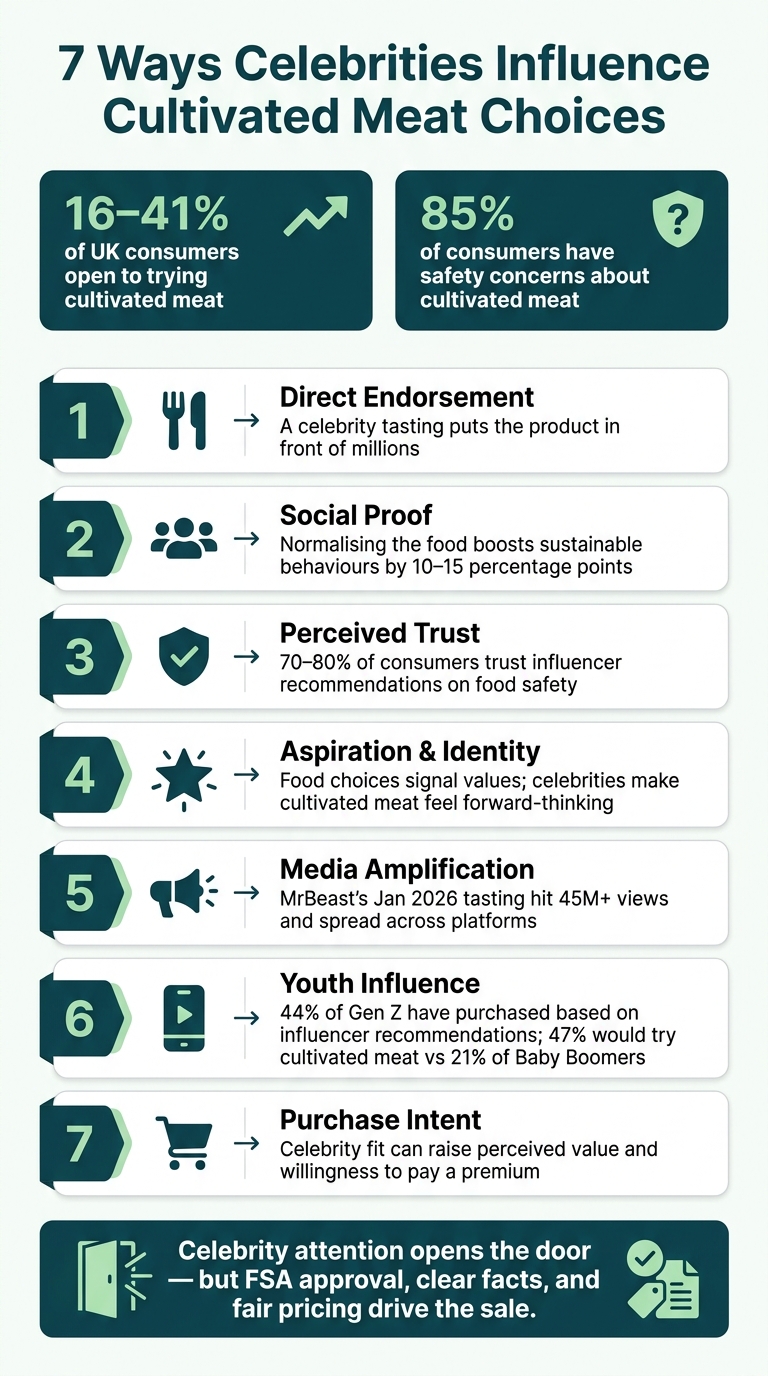
7 Ways Celebrities Influence Food Choices: Key Stats & Mechanisms
Quick Comparison
| Way it influences food choice | What it does |
|---|---|
| 1. Endorsement | A famous person tries or backs the food |
| 2. Social proof | Repetition makes the food seem normal |
| 3. Trust | A familiar face can lower doubt |
| 4. Identity | The food starts to say something about you |
| 5. Media spread | Clips, reposts and news keep it visible |
| 6. Younger audience effect | Gen Z is more likely to act on creator cues |
| 7. Buying effect | Interest can turn into trial if price and approval fit |
In short: public campaigns and celebrity attention can spark interest, but it does not replace safety checks, clear facts, or FSA approval.
sbb-itb-c323ed3
1. Direct Endorsement and Brand Association
When a celebrity publicly backs a food product, whether through an advert, an investment, or an on-camera tasting, some of their credibility can rub off on the product. That can make people more willing to try something they may have ignored before.
This matters even more for Cultivated Meat. When a trusted public figure eats it in a familiar setting, the category can feel more normal. Less like a lab idea. More like food people might actually put on their plate.
There are limits, though. People are often wary of paid promotions, and the match between the celebrity and the product matters a lot. If the endorsement feels staged or overly commercial, its impact can fall fast.
"It is far more interesting to have other people who are passionate about the innovation telling other people and their friends and their followers, rather than it coming from a brand." - Jake Crumbine, Global Head of Influence, Impossible Foods [1]
That reaction matters because a familiar face can act as a trust signal. For Cultivated Meat, the strongest endorsements are usually the simplest ones: a real tasting moment, not a polished sales pitch. That public approval then feeds the next effect: social proof.
2. Social Proof and Trend Signalling
When one celebrity tries a food, it can look like a one-off stunt. When several do, it starts to look like a pattern. That's social proof. And for Cultivated Meat, that change matters. Repeated visibility can turn simple curiosity into a social cue.
You can already see this in consumer willingness to try the product. In the UK, only 16–41% of people are currently open to trying Cultivated Meat [1]. But when people see that others accept it, attitudes can shift. In UK research, showing that other people accepted Cultivated Meat increased participants' interest, purchase intent, and willingness to include it in their diets [5].
The same pattern shows up more broadly too. Normalising lower-impact food choices can increase uptake by 10–15 percentage points compared with facts alone [6]. That's why moments on social media matter so much. The January 2026 MrBeast tasting is a good example: one clip didn't just sit there as an isolated post. As it spread across platforms, it became a trend signal, pushing Cultivated Meat into a much bigger public conversation [2][7].
"The future of meat will be shaped not just in stainless-steel tanks and policy briefs, but in the feeds of the next generation, who will decide what 'normal' meat looks like." - Sonalie Figueiras, Editor-in-Chief, Green Queen [2]
That said, this only works if the signal feels genuine. If people read a post as a paid plug, the effect drops off. And when mega-influencer posts can cost more than £960,000, scepticism isn't hard to understand [1][8].
3. Perceived Trust and Reduced Uncertainty
Social proof helps, but unfamiliar foods still bring a lot of questions. People want to know if the food is safe, how it is made, and what it will taste like.
Cultivated Meat is a clear example. Many UK consumers still ask how it is produced, what it tastes like, and whether it is safe to eat. 85% of consumers harbour concerns about Cultivated Meat, with safety sitting at the top of that list [1]. That’s a huge barrier, and facts on their own often don’t make that worry go away.
This is where celebrities and scientists play different parts. Scientists build trust with evidence. Celebrities do it through familiarity and social permission. In plain terms, a well-known person can make something new feel less strange. That matters most when people are judging whether a product feels safe enough to try.
Seeing a familiar face eat Cultivated Meat on camera can make the product feel less unknown. It gives people a kind of reassurance that a press release simply can’t match.
Still, celebrity trust only goes so far. A famous person can spark interest and lower hesitation, but FSA approval and clear safety evidence are what shape whether consumers feel comfortable buying.
4. Aspiration and Identity Shaping
Once a food feels believable, celebrities can make it feel personal too.
Food has never been only about hunger. What people eat says something about who they are, or who they’d like to be. When a well-known person backs a food choice, they attach meaning to it. Eating what a celebrity eats can feel a bit like borrowing part of their image, whether that means being health-conscious, environmentally aware, or simply ahead of the curve. Researchers call this identity fit: people tend to lean towards products that match how they see themselves, or how they want others to see them [3]. Younger consumers, in particular, often use food choices to signal their values and sense of self, falling into specific market segments [2]. In that setting, celebrities can make a product feel like an expression of the buyer, not just something they picked up.
That’s why one public tasting can do more than show approval. It can hint at status too. Cultivated Meat fits neatly into that pattern. For consumers who want to be seen as forward-thinking or sustainability-minded, it offers what Uma Valeti describes as the best of both worlds:
"What if we can have the best of both worlds… LOVE chicken and LOVE chickens!" - Uma Valeti, Founder and CEO, Upside Foods [2]
Links with well-known figures like MrBeast help shift Cultivated Meat from niche food tech to something people may want to be associated with [2][7]. That kind of visible backing can turn Cultivated Meat into a status marker, not just a novelty.
But there’s a catch. The pull fades fast if Cultivated Meat seems exclusive instead of open to ordinary people. In the UK, only 16–41% of people are currently open to trying Cultivated Meat [1]. If the message feels too elite, that gap can grow. The identity angle works best when it feels open and welcoming, not like a luxury for a small circle.
That signal matters most when people see it again and again, until it starts to feel normal.
5. Media Amplification and Repeated Exposure
Once a celebrity tasting takes off, the media can blow up its reach. In January 2026, MrBeast's Cultivated Meat tasting went past 45 million views within days, then spread across news outlets and social platforms [7][8].
That repeat visibility helps Cultivated Meat seem normal. When the same food story shows up on YouTube, Instagram, TikTok and in mainstream news - through headlines, reposts, reaction clips and follow-up coverage - it starts to feel less like a niche topic and more like something people are already talking about.
The tone matters as well. MrBeast's low-key style kept the focus on eating the product, not on the science behind it. That helped frame Cultivated Meat as ordinary food, rather than something from a lab [7][8]. For a broad audience, that can make a big difference.
“Without accurate follow-up, viral attention fades fast.”
There’s a catch, though. Amplification doesn’t always help. Coverage can blur what the category actually is, and that can weaken the effect of the first moment.
This matters even more for younger viewers, especially when they keep seeing the same food story across several feeds.
6. Stronger Influence on Younger Audiences
Repeated exposure has the biggest effect on younger audiences. They’re more likely to respond to celebrity and creator cues, and the data makes that plain. 44% of Gen Z consumers have made purchasing decisions based on recommendations from social influencers [1], and in the UK, 47% of Gen Z say they would eat Cultivated Meat, compared with 21% of Baby Boomers [9].
For Gen Z and Gen Alpha, creator recommendations often feel less like adverts and more like peer signals. If someone they follow tries something new and seems openly enthusiastic, the product can shift from “strange” to “worth trying”. That creates a friend-like sense of trust. And when several creators post about the same product, it starts to look normal rather than niche. Research suggests that this kind of peer signal can increase sustainable food behaviours by 10 to 15 percentage points [6].
That puts younger consumers in the strongest position to become early adopters of Cultivated Meat. A viral tasting video can spark curiosity, but it can’t do the job of clear information on production, regulation and ingredients. If buzz moves faster than understanding, confusion can set in fast.
What moves curiosity towards informed interest is clear, evidence-based information. That’s what helps turn attention into purchase intent.
7. Purchase Intent and Willingness to Pay
Awareness doesn’t equal purchase. A celebrity can put a product on someone’s radar, but the last hurdle is often the price tag. When the fit between the celebrity and the product is strong, endorsements can lift perceived value and make people more willing to pay more [4].
That extra visibility can push interest closer to an actual buying choice. But willingness to pay depends on more than fame alone. In the UK, only 16–41% of people are currently open to trying Cultivated Meat [1]. On top of that, cost-of-living pressure and price gaps between bioreactor and traditional methods make people far more careful about what they spend, so price sensitivity is a real barrier.
UK consumers also place a lot of weight on Food Standards Agency (FSA) approval. In fact, they rank it above “slaughter-free” and “antibiotic-free” claims [1].
In practice, celebrity influence works only when trust, price and regulation line up. Fame may spark interest, but regulation and price are what decide if that interest turns into a sale.
Quick Comparison of the 7 Influence Mechanisms
The table below lines up the seven mechanisms side by side. They overlap in places, but each one nudges people in a slightly different way.
| Mechanism | How It Works | Consumer Effect | UK Relevance |
|---|---|---|---|
| 1. Direct Endorsement | Celebrity backing lifts visibility and legitimacy. | High awareness; product feels more credible [1][4]. | Puts Cultivated Meat on the radar of UK shoppers [1]. |
| 2. Social Proof | Normalises the category and reduces stigma. | Reduces disgust; boosts sustainable behaviours by 10–15 percentage points [6]. | Normalises it in familiar meals [6]. |
| 3. Perceived Trust | Trusted faces lower safety anxiety. | 70–80% trust influencer recommendations on food safety [1]. | Addresses UK safety and nutrition concerns and complements FSA messaging [1]. |
| 4. Aspiration & Identity | Makes Cultivated Meat feel identity-affirming. | Willingness to try new foods to match an ideal self [3][4]. | Positions it as forward-looking [4]. |
| 5. Media Amplification | Turns a tasting into mainstream awareness. | Moves it into mainstream conversation as global industry momentum builds [2]. | Cuts through stigma in mainstream media [1][2]. |
| 6. Youth Influence | Reaches younger audiences where they already spend time. | 44% of Gen Z have made purchasing decisions based on influencer recommendations [1]. | Shapes dietary habits of the next generation of UK buyers [1][2]. |
| 7. Purchase Intent | Increases trial and price tolerance. | Greater willingness to try and pay a premium [4]. | Supports a higher starting price [4][6]. |
Taken together, these mechanisms help decide whether Cultivated Meat feels credible, normal and worth trying.
Conclusion
Put together, these seven mechanisms point to one simple idea: celebrity attention can make something new feel normal. It does more than put a topic in front of people. It helps the unfamiliar feel familiar.
That matters for Cultivated Meat. About 85% of consumers still have safety and nutritional profiles [1], and celebrity attention on its own won't fix that. As Barsha Dutta said, "In food innovation, technology builds products. Culture builds demand." [7] That’s the handoff from attention to adoption: celebrity attention may open the door, but clear, honest information about how Cultivated Meat is made and what FSA approval means is what helps people keep moving.
Cultivated Meat Shop supports that shift with clear, consumer-focused information that turns curiosity into confidence.
FAQs
Why do celebrities make new foods feel more normal?
Celebrities can make new foods feel more normal by linking a niche idea to everyday life. When a well-known public figure tries Cultivated Meat or visits a production site, the concept starts to feel less abstract and more like actual food people might eat.
That shift matters. When it’s framed as a food experience instead of a far-off theory, people are often less wary and less likely to cling to negative myths. This kind of public approval can help more people see it as a practical, everyday option.
Can celebrity attention really reduce safety worries?
Yes, but it depends on how the message is delivered.
Celebrities can help normalise Cultivated Meat and bring more attention to it. That kind of visibility matters. But there’s a catch: some people may see celebrity support as commercial or a bit staged.
Safety concerns tend to ease more when celebrity attention is backed by trusted experts and micro-influencers. Their more personal, behind-the-scenes content can make production feel less mysterious and help build trust over time.
Why are younger people more open to Cultivated Meat?
Younger generations are often more open to Cultivated Meat because they tend to see it in a way that feels concrete and familiar. Instead of meeting it as a dry science topic, they come across it as something fun, tasty and tied to the way they live, eat and spend time online.
Influencers and creators play a big part here. They help explain how it’s made in plain English, which can make the whole idea feel less strange. That shift matters. When people get honest, relatable content instead of hype or jargon, fear often gives way to curiosity.
Cultivated Meat Shop supports that same process by giving people clear, useful guidance as they look into the category.


