

Cultivated meat is reshaping how we think about food costs. With production costs dropping from £1.8 million per kilogramme to £29 - and expected to reach £8.40 soon - it’s clear that this alternative protein is becoming more affordable. By using fewer resources like water, land, and feed, cultivated meat offers a solution to rising food prices while reducing the impact of traditional farming methods.
Key points:
- Cost reductions: Cultivated meat prices have fallen by 99% since its inception, with projections suggesting price parity with conventional meat by 2035.
- Resource efficiency: Producing cultivated meat uses up to 96% less water and 99% less land compared to current farming methods.
- Market growth: Valued at £800 million in 2024, the market is expected to grow to £8.6 billion by 2033.
- Hybrid products: Combining cultivated meat with plant-based ingredients offers a more affordable entry point for consumers.
With advancements in production and scaling, cultivated meat is set to become a practical, cost-effective choice, addressing both household budgets and long-term food challenges.
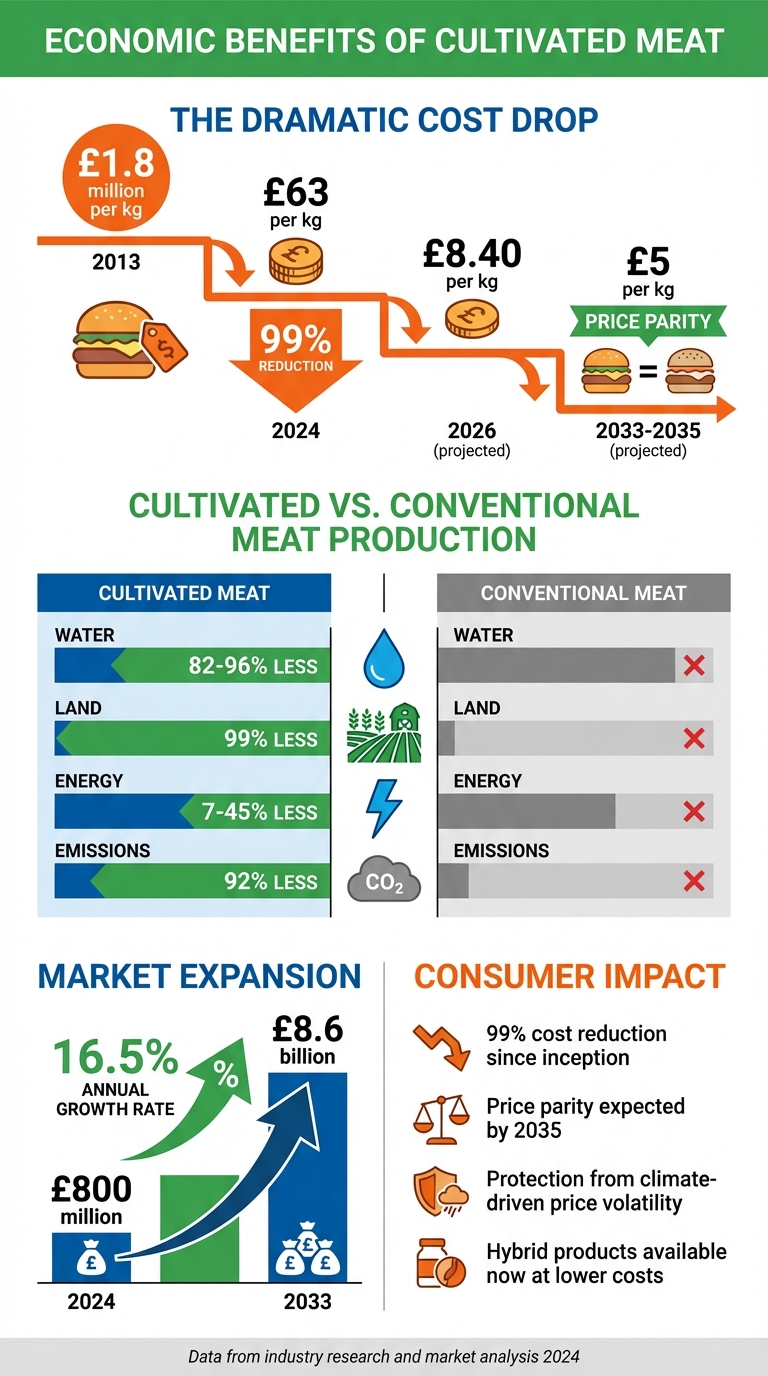
Cultivated Meat Cost Reduction Timeline and Resource Efficiency Comparison
The True Cost of Conventional Meat Production
Resource Demands and Their Impact on Prices
The price of meat in supermarkets reflects the entire process, from raising animals to getting the product on shelves. The USDA Economic Research Service uses the "Food Dollar" metric to break down these costs, showing how value is added at each stage of the supply chain. One key factor here is the price spread - the difference between what farmers earn and what consumers pay - which captures the expenses of production, processing, and marketing. Rising costs for essentials like feed, water, and land, tracked by the Producer Price Index (PPI), directly push up retail prices.
The challenge? Meat production heavily relies on land, yet it delivers a relatively low nutritional return. Transitioning to cellular agriculture offers significant environmental benefits by reducing these resource pressures. With global meat consumption expected to double by 2050, this system faces significant risks from price swings[4][5]. These rising input costs are a major contributor to the unpredictability of meat prices.
Environmental Costs and Their Impact on Future Prices
Environmental factors add another layer of expense to meat production. Livestock farming is a major contributor to emissions, with a significantly higher carbon footprint than cultivated meat, accounting for 14–18% of global greenhouse gases and 32% of methane emissions worldwide. Ruminants, in particular, are responsible for about 80% of this methane output[5].
Events like the 2022 outbreak of Highly Pathogenic Avian Influenza also show how external factors can disrupt prices. This incident caused egg prices to jump by 32.2%, followed by another increase of 21.9% in 2025[6]. Similarly, beef, veal, and cattle prices are forecasted to rise by approximately 10% by 2026[6].
"Livestock production accounts for 14-18 percent of global greenhouse gas emissions, including 32 percent of methane gas emissions worldwide."
– Stanford Woods Institute for the Environment[5]
Future climate policies, such as carbon taxes, will likely raise costs even further. According to Professor Larry Goulder from Stanford University, these policies aim to be both economically efficient and equitable[5]. With food-at-home prices expected to climb by 3.1% in 2026 - outpacing the 20-year average of 2.6% - it’s clear that the conventional meat production model is becoming increasingly costly[6].
sbb-itb-c323ed3
How Cultivated Meat Is Becoming More Affordable
Production Advances That Lower Costs
Over the last decade, the cost of producing cultivated meat has dropped dramatically. Back in the day, the first cultivated beef burger came with a staggering price tag of $2.3 million per kilogramme. Today, that cost has plummeted to $63 per kilogramme - a huge leap forward, though it's still higher than traditional meat prices[1]. This progress is thanks to innovations in bioreactor technology, improved cell growth techniques, and cheaper growth media.
Bioreactors, once reliant on costly pharmaceutical-grade equipment, have transitioned to food-grade systems tailored for meat production. These advancements, combined with bulk buying of key inputs like glucose, have slashed costs by up to 75%[3]. Optimised cell lines have also played a pivotal role, enhancing growth efficiency and cutting costs by an incredible 99% since the early prototypes[2][3].
In August 2024, Believer Meats, led by Professor Yaakov Nahmias from Hebrew University of Jerusalem, achieved a major milestone in continuous manufacturing. Using tangential flow filtration in bioreactors, they managed to produce 130 billion cells per litre with a 43% yield over 20 days. This method allows for daily harvesting and has brought cultivated chicken production costs down to $6.20 per pound (roughly £4.80 per pound) in a 50,000-litre facility - on par with organic chicken prices[8].
These advancements mark a significant step towards making cultivated meat as affordable as conventional options.
When Cultivated Meat Will Match Conventional Prices
Thanks to these production breakthroughs, experts believe cultivated meat could match the price of conventional meat within the next decade. McKinsey predicts that in about 10 years, cultivated meat might even be cheaper, with production costs dropping to under $5 per pound (around £4 per pound) due to a 99.5% reduction in costs[3].
Mosa Meat has already shown what's possible, cutting the cost of a small-scale burger from US$280,000 in 2013 to an estimated US$10 (approximately £8) in just two years through scaling[3][7]. As production scales up globally, the cultivated meat market - which was valued at over $1 billion in 2024 - is projected to reach $10.8 billion by 2033, growing at an annual rate of 16.5%[2]. Moreover, consumer interest could rise by 27–55% once prices align with or drop below those of traditional meat[1].
With efficiency gains and global scaling driving costs lower, cultivated meat is well on its way to becoming a practical, affordable choice for everyday consumers. For a deeper dive into these advancements and market trends, check out Cultivated Meat Shop.
Long-Term Economic Benefits Through Resource Efficiency
Reduced Environmental Costs
Traditional livestock farming carries hidden costs that consumers ultimately bear. The sector contributes 14.5% of global greenhouse gas emissions, mainly through methane and nitrous oxide[2]. As countries, including the UK, push towards net-zero goals, these emissions could lead to carbon taxes and environmental levies, driving up meat prices. For instance, proposed carbon border adjustment mechanisms and potential farm emissions charges in the UK could increase beef prices by £1–2 per kilogramme by 2030[2]. Cultivated meat, when produced with renewable energy, can cut emissions by up to 92% compared to conventional beef[2], potentially exempting it from such additional costs. Moreover, climate-related disruptions often inflate traditional meat prices, whereas cultivated meat’s smaller environmental impact could contribute to more stable pricing in the long run. These environmental benefits pave the way for more cost-effective production systems.
More Efficient Production Methods
Conventional beef production is well-known for its inefficiency when it comes to resource use. Cultivated meat, on the other hand, directly grows cells, avoiding the waste associated with traditional farming. This process uses 82–96% less water, 99% less land, and 7–45% less energy compared to conventional methods[2][9]. As production becomes more efficient and the industry scales up - estimated to reach a global market value of £8.5 billion by 2033 according to the cultivated meat timeline[2] - UK consumers could see more competitive pricing and stable supply in an increasingly unpredictable food market. These advancements suggest a shift towards a more resource-conscious and economically sustainable food system.
Cost drivers of cultivated meat production
Hybrid Products as an Affordable Entry Point
As production methods improve and costs come down, hybrid products are emerging as a cost-effective option for consumers looking to explore Cultivated Meat.
Broader Access Through Cost Reduction
Hybrid products combine Cultivated Meat with plant-based ingredients, lowering costs by relying less on expensive biomass. Instead, they use affordable agricultural byproducts as scaffolds to support cell growth. These plant-derived materials - like textured vegetable protein, soy, wheat, and rice bran - help reduce production expenses. For example, rice bran-gel composite scaffolds can cut scaffold costs to just 37% of what pure gelatin systems require. Additionally, studies show that polysaccharide–protein hydrogel-based cultured pork meets the essential amino acid profile of commercial pork tenderloin. By replacing costly culture media and synthetic scaffolds with agricultural byproducts, producers can further drive down costs as they scale up production efficiency [10].
Introducing Consumers to Cultivated Meat at Lower Costs
Hybrid products also make it easier for UK consumers to try Cultivated Meat without waiting for price parity with traditional meat. While production costs are currently around £63 per kilogramme, the industry aims for optimised targets of £1.95 per kilogramme. In the meantime, hybrid products offer a more affordable entry point, helping build consumer trust and familiarity with this new category. As regulatory approvals expand in countries like Singapore, the United States, and Israel, UK consumers have the chance to explore these products early. Platforms such as Cultivated Meat Shop provide clear, reliable information about product composition and benefits, easing the introduction of this innovative food category as the market evolves [10].
Conclusion: Economic Benefits for Consumers and the Food System
Cultivated Meat offers a compelling economic opportunity for consumers, combining immediate affordability with the promise of long-term savings. Since the early prototypes, production costs have dropped by an incredible 99%, and experts predict that with continued scaling and manufacturing advancements, prices could fall to around £5 per kilogramme within the next decade. This progress positions Cultivated Meat to achieve price parity with traditional meat, making high-quality proteins more accessible to a wider audience. For consumers, this means not only savings but also access to premium meat products at a reasonable cost.
One of the key advantages of Cultivated Meat lies in its ability to address the inefficiencies of conventional livestock farming. By drastically cutting resource use, it reduces production expenses and shields against the rising costs often tied to environmental impacts.
The market for Cultivated Meat is also set for massive growth. Projections show it expanding from £790 million in 2024 to an estimated £8.5 billion by 2033. As production scales and shifts from niche premium offerings to high-volume availability, UK consumers can expect increasingly competitive prices. Regulatory approvals are paving the way for mass-market production, meaning this shift could happen sooner than many expect.
Consumers in the UK can already tap into this evolving market through platforms like Cultivated Meat Shop. These resources provide easy-to-understand information about product composition, pricing trends, and availability, helping households prepare for a future of affordable, sustainable meat. Features like waitlist sign-ups ensure consumers stay informed about new developments, blending economic and environmental benefits for both individual budgets and the larger food system.
Backed by over £2.4 billion in investments and driven by more than 150 companies worldwide, the transformation of the meat industry is well underway. As production scales up and hybrid products become more common, consumers will enjoy lower prices, more options, and a food system that delivers real meat without the heavy resource demands of traditional farming. This marks a significant step forward for both household savings and global sustainability.
FAQs
When will cultivated meat be cheaper than conventional meat in the UK?
Cultivated meat is set to become a cost-friendly alternative to conventional meat in the UK by around 2030. By this time, its production costs are expected to fall to roughly £4 per kilogram, putting it on par with the price of meat from traditional farming methods.
Will cultivated meat stabilise meat prices during shortages and price spikes?
Cultivated meat offers a promising way to stabilise prices, especially during shortages or sudden price spikes. Thanks to advancements in production methods and scaling up operations, it could help lower costs and reduce dependence on traditional meat markets, which are often more prone to unpredictable fluctuations.
Are hybrid cultivated meat products likely to be the first affordable options for shoppers?
Hybrid cultivated meat products, like burgers and nuggets, are likely to be among the first to reach an affordable price point. These products are simpler to produce compared to whole cuts, which makes them a more practical starting point. As advancements in production technology continue, costs are expected to drop, making these options increasingly accessible to the general public.


