

Cultivated meat offers a new way to enjoy meat without the need for animal slaughter or intensive farming. It’s grown from animal cells in controlled environments, producing real meat with the same taste, texture, and nutritional value as conventional options. Here’s why it matters:
- Ethical Production: No slaughterhouses or factory farms - just a small, painless cell sample from a living animal.
- Lower Impact: Uses up to 90% less land, reduces climate impact by up to 92%, and cuts air pollution by up to 94% compared to beef.
- Health Benefits: No antibiotics and reduced risk of foodborne illnesses like E. coli or Salmonella.
- Flexitarian-Friendly: Perfect for those reducing meat consumption but not ready to go fully plant-based.
Cultivated meat is biologically identical to farmed meat, making it a strong alternative for those seeking to balance their diet with ethical and environmental considerations. It’s expected to become widely available in the UK by 2027, with early products focusing on minced forms, hybrid options, and cultivated fat for plant-based recipes. Stay informed through platforms like the Cultivated Meat Shop for updates and early access opportunities.
The future of meat? Inside the Oxford-based startup turning cells into 'steaks'
What is Cultivated Meat?
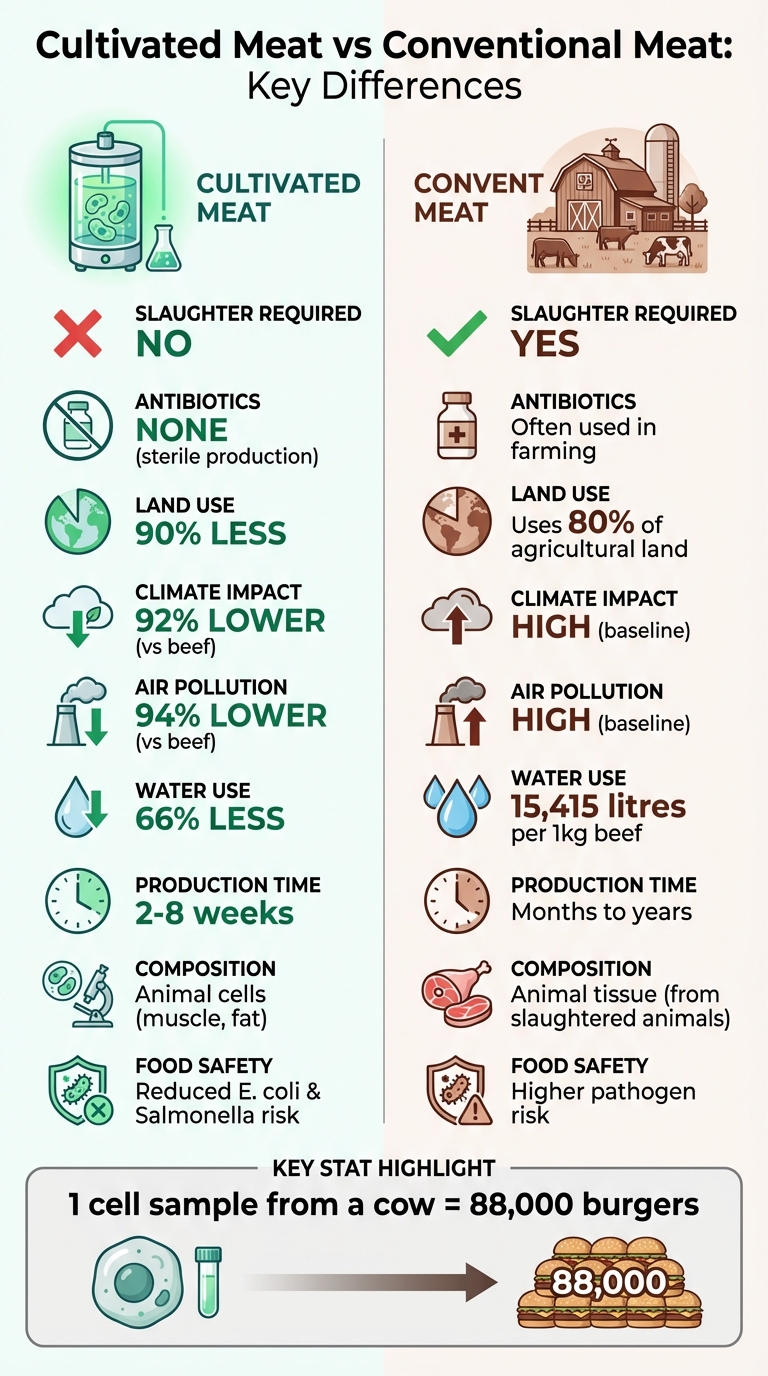
Cultivated Meat vs Conventional Meat: Environmental Impact and Production Comparison
Cultivated meat is real meat, but instead of coming from a slaughtered animal, it's grown directly from animal cells in a controlled, sterile setting. It’s made up of the same muscle, fat, and connective tissue you’d find in a chicken breast or beef burger.
The big difference lies in how it’s made. Rather than raising and slaughtering an animal, scientists focus on growing just the edible parts. This idea, which once seemed futuristic, is now a reality.
In December 2020, GOOD Meat, a division of Eat Just, made history by receiving the first regulatory approval in Singapore to sell cultivated meat. Their product - chicken nuggets - was served at the restaurant 1880, created using cells taken from a feather naturally shed by a chicken named Ian [4]. By June 2023, the USDA and FDA approved UPSIDE Foods and GOOD Meat to sell cultivated chicken in the United States [1].
How Cultivated Meat is Made
The process of making cultivated meat is both efficient and ethical. It starts with a tiny, painless biopsy from a living animal - about the size of a peppercorn. From this small sample, an astonishing amount of meat can be produced. For instance, a single sample from a cow can yield enough cells to make 88,000 burgers [4].
These cells are then placed in bioreactors, which function much like fermentation tanks. Here, they’re fed a nutrient-rich growth medium containing amino acids, vitamins, glucose, and minerals [2]. As the cells multiply, they’re directed to form specific tissues: muscle, fat, and connective tissue. For simpler products like nuggets or mince, the cells are harvested and processed directly. For more intricate cuts, such as steaks, the cells are grown on scaffolds made from food-grade materials like plant proteins or cellulose, which help create the desired structure and texture [9].
Depending on the species, the cultivation process takes between two and eight weeks [7]. Back in 2013, Professor Mark Post and his team at Maastricht University introduced the world’s first cultivated beef burger at a public event in London. While that first burger cost a whopping £250,000 to produce, advancements in technology have since slashed production costs dramatically [1].
Cultivated Meat vs Conventional Meat: What's Different?
Now that we know how it's made, let’s see how cultivated meat stacks up against traditional meat. The end product is biologically identical to meat from a farm, containing the same proteins, fats, and nutrients (yes, even cholesterol and saturated fats). The key differences lie in the production process.
| Feature | Cultivated Meat | Conventional Meat |
|---|---|---|
| Composition | Animal cells (muscle, fat) | Animal tissue (from slaughtered animals) |
| Slaughter Required | No | Yes |
| Antibiotics | None (sterile production) | Often used in farming |
| Land Use | Up to 90% less | Very high |
| Taste/Texture | Identical to meat | As expected |
Since cultivated meat is grown in a sterile environment, there’s no need for antibiotics, and it significantly reduces the risk of foodborne illnesses like E. coli or Salmonella. It’s also far more resource-efficient, cutting land use by up to 90% and reducing air pollution by as much as 94% compared to conventional beef production [2]. For those looking to reduce their meat consumption without sacrificing taste or texture, cultivated meat offers a way to enjoy the same flavours while addressing ethical and environmental concerns tied to traditional farming.
Why Cultivated Meat Works for Meat Reducers
Cultivated meat provides a practical alternative for those looking to cut down on traditional meat consumption. It tackles key concerns about health, the planet, and the ethical treatment of animals. Let’s dive into its health, environmental, and animal welfare benefits.
Health Benefits
One standout feature of cultivated meat is its production in sterile bioreactors. Unlike conventional farming, which often depends on antibiotics to prevent disease in overcrowded conditions, cultivated meat bypasses this issue entirely. This is crucial because antibiotic overuse in farming has contributed to the rise of antibiotic-resistant "superbugs." As Georgia Rundle, Trainee Patent Attorney at Marks & Clerk, explains:
"Livestock farming relies heavily on antibiotics, fuelling the rise of antibiotic resistance. Lab-grown or cultivated meat has emerged as a green solution to these issues" [11].
The controlled environment also significantly lowers the risk of foodborne illnesses, such as E. coli and Salmonella, which can result from faecal contamination during traditional slaughter processes [10]. Beyond safety, cultivated meat allows producers to adjust its nutritional content. For example, a 2025 study in Aquaculture Reports by Y. Xie and G. Zhang found that cultivated rainbow trout meat contained higher levels of free amino acids and fatty acids compared to its naturally farmed counterpart [10].
Additionally, companies like Uncommon are pushing innovation further. This Cambridge-based startup uses mRNA technology to guide pig cells into forming bacon and pork belly. Since the mRNA naturally breaks down without altering the cell's DNA, the resulting pork is classified as non-GMO and produced without antibiotics, which are a mainstay in industrial pig farming [11]. These advancements make cultivated meat an attractive choice for those prioritising health and ethics.
Environmental Benefits
Switching to cultivated meat could dramatically shrink the environmental footprint of meat production. Traditional livestock farming consumes nearly 80% of agricultural land while contributing less than 20% of the world's calories [5]. Producing just 1 kilogram of conventional beef demands a staggering 15,415 litres of water, with pork and chicken requiring about 6,000 and 4,325 litres, respectively [5].
Cultivated meat, on the other hand, uses up to 90% less land compared to conventional beef and 64% less than chicken [13]. It also curbs emissions of potent greenhouse gases like methane and nitrous oxide, which are byproducts of traditional farming methods [12]. While the current process for cultivated meat production uses around 5.5 times more energy than conventional methods [13], relying on renewable energy can make its greenhouse gas emissions far lower than those of beef. These factors highlight its potential as a more sustainable option.
Animal Welfare
For many, the ethical treatment of animals is a major motivator to reduce meat consumption. Cultivated meat eliminates the need for raising and slaughtering animals because it’s produced directly from animal cells in a controlled setting [14].
"Cell-cultivated products are made without raising or slaughtering animals." – Food Standards Agency [14]
Research shows that 59% of people believe cultivated meat offers meaningful benefits for animal welfare. UK consumers, in particular, highly value its "slaughter-free" nature [14]. A notable example is UPSIDE Foods, which began trial production of cultivated chicken fillets in June 2023 at an urban factory in California. These fillets are identical to conventional chicken at the cellular level but are produced entirely without the need for a slaughterhouse [15].
Taste and Texture: How Does Cultivated Meat Compare?
For those cutting down on meat, taste is a dealbreaker. If the flavour and texture don't hit the mark, it’s unlikely to replace traditional options. Early insights, however, suggest cultivated meat comes impressively close to the real thing.
What Cultivated Meat Tastes Like
Cultivated meat replicates the tissue structure of conventional meat. This means it delivers the same sizzle and mouth-watering aroma you'd expect from a classic cut [5][16]. When cooked, it undergoes the Maillard reaction - the chemical process that gives a perfectly seared steak or burger its rich, savoury flavour [17][19].
Initial taste tests have been encouraging. In one trial featuring hybrid cultivated chicken, participants scored it an average of 8/10 when asked if they’d swap it for their usual meat [19]. Another study described cultivated chicken as having "remarkable similarities" to its traditional counterpart in taste and sensory qualities [19].
Texture is another area where cultivated meat shines. BBC Science Correspondent Pallab Ghosh sampled a cultivated steak prototype from Ivy Farm Technologies and observed:
"The texture, when cut, is indistinguishable from the real thing. That's our goal. We want it to be as close to a normal steak as possible." – Riley Jackson, Ivy Farm Technologies [16]
While ground products like mince and burgers are easier to imitate, whole cuts such as steaks require more advanced methods. Techniques like edible scaffolding help organise cells into fibrous structures, recreating the chew and bite of conventional meat [16][18].
Cultivated Meat vs Plant-Based Alternatives
These positive results underline how cultivated meat could meet the expectations of those reducing their meat consumption. Unlike plant-based options made from soy or pea protein, cultivated meat is real animal tissue, which gives it a natural edge in taste. In one preference test, 67% of participants chose a hybrid cultivated chicken product over a soy-based alternative [19].
One key factor is fat. Cultivated animal fat carries flavour far better than the plant oils (like coconut or canola) used in plant-based products. Gustaf Brandberg, Founding Partner at Gullspång Invest, sampled Mission Barns' cultivated bacon and remarked:
"A lot of the taste is carried through the fat, so what stands out compared to other plant-based alternatives is how closely it mimics meat." [20]
To balance flavour and cost, many companies are introducing hybrid products that blend cultivated animal cells with plant-based proteins [16][19]. Dr. Harsh Amin, CEO of Ivy Farm Technologies, explained their focus:
"If you want to make a sustainable difference, you have to go for mass production and burgers are where the masses are." [16]
For those who’ve tried plant-based substitutes and found them lacking, cultivated meat offers a closer experience to traditional meat - because it is meat, just created in a new way.
sbb-itb-c323ed3
How Cultivated Meat Fits into a Flexitarian Diet
For those choosing to cut back on meat rather than eliminating it altogether, cultivated meat offers a practical compromise. It provides the full culinary experience of traditional meat while sidestepping many of the environmental challenges and ethical concerns tied to conventional farming. This makes it an ideal option for a flexitarian lifestyle, where plant-based foods take centre stage, complemented by moderate meat consumption. The balance it strikes between authentic flavour and reduced impact is what makes it so appealing for this approach.
Cultivated meat replicates the taste, texture, and nutritional benefits of conventional meat, while significantly lowering its environmental footprint - reducing the climate impact of beef by up to 92% [3][21]. For those aiming to make more sustainable choices, it offers a meaningful way to reduce their impact without giving up meat entirely.
Ways to Use Cultivated Meat in Your Meals
Given its benefits, incorporating cultivated meat into your meals is straightforward and versatile.
It can seamlessly replace traditional meat in a wide range of everyday dishes. Early products will likely be available in minced or ground forms, making them perfect for recipes like burgers, meatballs, spaghetti bolognese, tacos, or cottage pie [1][21].
Another option is hybrid products that combine a small amount of cultivated meat with plant-based ingredients. In May 2024, Eat Just introduced the world’s first retail cultivated meat product at a butcher shop in Singapore. This product contained 3% cultivated chicken meat blended with plant-based components, showing how a hybrid approach can offer the taste of meat while being more accessible [22]. These blends provide a stepping stone for flexitarians, bridging the gap between fully plant-based meals and traditional meat.
Additionally, cultivated animal fat is on the horizon as an ingredient in plant-based foods. Since fat is a key carrier of meat’s flavour, incorporating cultivated fat into plant-based burgers or sausages can elevate their taste and improve their cooking performance.
How Cultivated Meat Supports Flexitarian Goals
Cultivated meat aligns perfectly with the principles of a flexitarian diet by reducing harm, improving health, and cutting environmental impact - all while allowing you to enjoy the foods you love. Produced in controlled conditions, it eliminates the risks tied to conventional farming and tackles inefficiencies in the food system. For example, traditional chicken farming requires nine calories of feed to produce just one calorie of meat, while cultivated meat is estimated to be nearly three times as efficient [3].
Ethically, cultivated meat offers a significant advantage. It’s produced through a painless biopsy from a living animal, which continues its normal life afterwards. For those uncomfortable with the idea of slaughter but not ready to embrace a fully plant-based diet, this provides a compelling alternative [2][3]. In fact, about 33% of UK consumers are already open to trying cultivated meat [21]. With its combination of sustainability, efficiency, and ethical production, cultivated meat is an excellent choice for anyone looking to enjoy meat in a more responsible way.
Availability and What's Next for Cultivated Meat
When Cultivated Meat Will Be Available in the UK
Cultivated meat is anticipated to hit the UK market by early 2027. This timeline aligns with the Food Standards Agency's (FSA) pledge to complete safety assessments for two products within a two-year period starting in March 2025 [23][24][25]. To support this process, the FSA has also introduced a £1.6 million 'Cell-Cultivated Products Sandbox', designed to accelerate approvals without compromising safety standards [27][28].
In a notable milestone, the UK became the first European country to approve and sell cultivated meat for pet food in February 2025. Meatly's 'Chick Bites', created from a single chicken egg cell, received backing from Defra in July 2024, paving the way for this innovative product to reach the pet food market [24][25][26].
"It is not deregulation, it is pro-innovation regulation... we are trying to get the regulation aligned with the needs of innovation and reduce some of the bureaucracy and duplication." - Lord Vallance, Science Minister [23]
Currently, eight companies are part of the FSA's regulatory sandbox. These include UK-based firms like Hoxton Farms, Roslin Technologies, and Uncommon Bio, alongside international players such as Mosa Meat from the Netherlands and BlueNalu from the US. By late 2026, around 15 additional applications are expected to join the pipeline [28]. However, all products must pass independent safety evaluations under Novel Food regulations before they can be sold to the public [27]. These steps are shaping the path for early adopters eager to explore cultivated meat.
How to Stay Updated and Get Early Access
As the regulatory landscape continues to evolve, staying informed is crucial. For those keen on early access to cultivated meat, the Cultivated Meat Shop offers a straightforward way to stay in the loop. By signing up on their website, you'll receive updates on product launches, early access opportunities, and exclusive previews. The platform also provides educational resources to help consumers understand this emerging industry [5].
For broader updates, keep an eye on the FSA's programmes via food.gov.uk and follow industry news from groups like GFI Europe to track policy developments and technological advancements.
Conclusion
Cultivated meat is shaping up to be a promising option for those looking to reduce their meat consumption without compromising on taste or nutrition.
For meat reducers, this alternative offers a solution that’s biologically identical to traditional meat. It contains the same muscle, fat, and connective tissue, but is produced with far less strain on natural resources, improved food safety measures, and higher animal welfare standards[7][6]. In essence, it’s real meat, just grown in a smarter, more efficient way.
The environmental benefits are hard to ignore. Cultivated meat can cut greenhouse gas emissions by up to 92%, reduce land use by 90%, and use 66% less water compared to conventional beef. Its sterile production methods also eliminate the need for antibiotics and significantly lower the risk of pathogens[7][30][6][8]. Experts predict that by 2040, it could account for as much as 35% of global meat production[29].
"Cultivated meat is genuine animal meat... produced by cultivating animal cells in a safe and controlled environment." – GFI[7]
Although it’s not yet available in the UK, progress is being made on regulatory frameworks to allow its introduction. To stay ahead of the curve, the Cultivated Meat Shop offers a convenient way to stay informed. From product launch updates to educational resources, it’s a one-stop shop for anyone curious about this new frontier. For those prioritising health, sustainability, and ethical considerations, cultivated meat is a practical and forward-thinking choice.
FAQs
How does cultivated meat differ from plant-based meat alternatives?
Cultivated meat is actual animal meat, but instead of coming from a farmed animal, it's grown directly from animal cells. On the other hand, plant-based alternatives are crafted from ingredients like legumes, grains, or soy, specifically designed to replicate the taste and texture of meat. What sets cultivated meat apart is that it contains the same muscle, fat, and nutritional components as traditional meat because, at its core, it is meat - just produced differently.
The main distinction lies in how they're made. Cultivated meat is produced using advanced cell-culture technology, which completely removes the need for animal slaughter. Meanwhile, plant-based options rely on a mix of plant proteins, oils, and flavourings to achieve their meat-like qualities. This difference means cultivated meat offers the same flavour and texture as conventional meat, while plant-based products often have a unique taste and feel.
For those in the UK exploring this emerging option, cultivated meat presents an ethical and environmentally friendly alternative to traditional meat. It uses far less land and produces significantly lower greenhouse gas emissions compared to livestock farming.
What environmental advantages does cultivated meat offer?
Choosing cultivated meat is a smart way to cut down the environmental impact of your diet. Unlike traditional livestock farming, producing cultivated meat can use up to 90% less land, consume significantly less water, and emit far fewer greenhouse gases. For example, methane emissions from animals are completely avoided, and the large-scale deforestation tied to grazing and feed production can be drastically reduced.
In the UK, livestock farming takes up around three-quarters of agricultural land. By swapping even a portion of your meat consumption with cultivated options, you could help free up land for rewilding projects or carbon capture initiatives. This shift aligns with the country’s net-zero targets, while also safeguarding biodiversity and cutting down on air and water pollution.
If you’re someone who enjoys a flexitarian lifestyle, cultivated meat offers an eco-friendly way to enjoy real meat. It’s a simple step towards lowering your carbon footprint without sacrificing flavour or quality.
When can we expect cultivated meat to be available in the UK?
Cultivated meat is expected to hit UK shelves by 2027, according to recent guidance from the Food Standards Agency. The agency plans to complete safety approvals within the next two years, paving the way for this new food option.
This development marks an important move towards providing a more sustainable and ethical alternative to conventional meat, reflecting the increasing demand for forward-thinking food solutions.


