

The Good Food Institute (GFI) is driving a shift in how meat is produced globally by supporting cultivated meat - a process that grows meat from animal cells without traditional farming. GFI works across science, policy, and business to lower production costs, improve technology, and make cultivated meat more accessible.
Key highlights:
- Global Impact: Cultivated meat uses up to 92% less carbon and 95% less land compared to beef.
- Research Focus: GFI has funded over £19 million for 129 open-access research projects since 2019.
- Regulatory Progress: Products are now approved in the US, Singapore, and Australia, with more countries reviewing them.
- Consumer Education: GFI promotes clear terminology like "cultivated meat" and offers resources to build trust and awareness.
With 174 companies in over 30 countries and £2.4 billion in investments, cultivated meat is moving closer to becoming a viable option for everyday diets.
2024 State of the Industry: Cultivated meat, seafood, and ingredients
Supporting Cultivated Meat Research
The Good Food Institute (GFI) is tackling the technical hurdles in cultivated meat production by offering targeted funding and open-access resources. Each year, GFI invites researchers to submit proposals focused on reducing costs, scaling up production, and improving taste and texture. Selected projects can receive funding of up to £240,000 [7][11].
What makes GFI stand out is its dedication to transparency and public sharing of research outcomes. All data, tools, and findings from funded projects are made freely available, creating a shared knowledge base that benefits the entire industry, not just individual companies. This approach accelerates advancements across the field [7][8].
"By providing open-access results, the research projects funded through GFI's Competitive Research Grant Program will help address key industry questions and build the foundation of the global alternative protein field."
- Austin Clowes, GFI Alum [8].
These funding efforts set the stage for transformative research projects, several of which are highlighted below.
Open-Access Research Projects
GFI directs its funding towards solving what it describes as "unsolved challenges" within the cultivated meat sector [8][9]. For example, Dr Peter Stogios at the University of Toronto is working on engineering lower-cost growth factors, a critical yet expensive component in cultivated meat production [6]. At Tufts University, the Kaplan Lab is addressing the lack of aquatic species resources by developing specialised myosatellite cell lines for cultivated Atlantic salmon [6][10].
Another project focuses on multi-omic profiling to create detailed genetic and metabolic maps of fish species, helping to refine cultivation conditions [6]. Dr Minic's team is investigating algal extracts as a replacement for costly albumin in growth media [6]. These projects share a unified goal: breaking down the technical and financial barriers that hinder progress.
One particularly striking development comes from Northwestern University, where researchers demonstrated that a commonly used stem cell medium could be manufactured for 97% less than its commercial counterpart [5]. Such breakthroughs not only address immediate challenges but also push the industry closer to scalable and sustainable production.
In addition to funding research, GFI simplifies access to vital resources like specialised cell lines and serum-free media, further accelerating innovation.
Providing Cell Lines and Serum-Free Media
Creating a new cell line from scratch can take anywhere from 6 to 18 months [5]. To overcome this delay, GFI acquires and distributes ready-to-use cell lines and media formulations, significantly improving research efficiency. In 2023, GFI collaborated with SCiFi Foods to make several suspension-adapted bovine cell lines and specific media formulations publicly available [10]. This partnership removed the lengthy process of developing these resources from scratch.
"High-quality cell lines are essential ingredients for making cultivated meat that is safe, nutritious, and tasty... By overcoming an obstacle that will affect the majority of cultivated meat research projects, we can lower the barrier to these downstream areas for innovation."
- GFI Resource [10].
By 2024, GFI's Cell Line Tracker catalogued nearly 75 available cell lines, allowing researchers to quickly find the resources they need [5]. The organisation is also working on "frozen farmyard" repositories, centralised banks of starter cells for livestock, poultry, and aquatic species [5]. For instance, Dr Mukunda Goswami at the Indian Council of Agricultural Research is using GFI funding to develop and analyse carp cell lines, focusing on their ability to differentiate for cultivated meat applications [6][5].
GFI also provides access to affordable, optimised media formulations like B8 media, a cost-effective alternative to the standard Essential 8 media [5]. Serum-free media can cost as little as £0.50 per litre [5]. By switching from pharmaceutical-grade to food-grade components, researchers can drastically reduce costs without compromising quality. These initiatives ensure that scientists worldwide have access to the tools they need without being held back by high expenses or delays.
Regulatory and Policy Support
Bringing cultivated meat from the lab to the dinner table requires more than just scientific advancements - it hinges on supportive and well-defined regulatory frameworks. Approval for cultivated meat relies on transparent, evidence-based processes that prioritise consumer safety while encouraging progress. The Good Food Institute (GFI) plays a critical role in collaborating with governments and food safety agencies to ensure these standards are met.
Global Regulatory Progress
GFI has been at the forefront of regulatory milestones for cultivated meat. In 2020, Singapore became the first country to approve and sell cultivated meat, with GFI providing expert consultation to its government during the process [1]. Since then, regulatory approvals have gained momentum. By October 2025, nine cultivated meat and seafood products had received approval across the United States, Singapore, and Australia [1].
In the United States, regulatory oversight is shared between the FDA and USDA, covering both production processes and labelling [12][14]. A significant development occurred in June 2025 when Wildtype introduced the world’s first cultivated seafood in a Portland, Oregon restaurant after receiving FDA pre-market clearance [3]. By October 2025, Believer Meats achieved USDA certification and label approval for cultivated chicken in North Carolina [3].
Globally, cultivated meat products are under regulatory review in at least nine countries or regions, including the EU, Israel, New Zealand, Switzerland, the UK, and South Korea [1][3]. In 2025, Food Standards Australia New Zealand (FSANZ) approved Vow’s cultivated quail, marking Australia’s first regulatory approval in this space [3].
These milestones demonstrate the growing acceptance of cultivated meat, and GFI continues to drive policy initiatives that shape fair and efficient regulatory frameworks worldwide.
Policy Work and Advocacy
GFI is actively involved in shaping the regulatory landscape for cultivated meat. The organisation provides expert recommendations to agencies like the FDA and USDA, focusing on labelling standards and dietary guidelines. For instance, in December 2021, GFI submitted formal recommendations to the USDA to ensure labelling for cultivated meat and poultry is clear and prevents consumer confusion [12].
In Europe, GFI collaborates with public authorities and food safety experts to maintain robust and transparent authorisation processes for novel foods. In October 2024, thanks to GFI Europe’s advocacy, the UK government announced the creation of a £1.4 million regulatory sandbox to enhance the Food Standards Agency’s expertise in cultivated meat regulation [13]. Seth Roberts, Policy Manager at GFI Europe, highlighted the importance of this initiative:
"Consumers need confidence in plant-based and cultivated meat in order to make sustainable choices." [13]
Beyond advocacy, GFI also works to prevent discriminatory legislation at state and federal levels. The organisation monitors global regulatory developments and connects cultivated meat producers with technical experts to assist them through risk assessments and application processes [13].
Through these efforts, GFI continues to lay the groundwork for a regulatory environment that supports innovation while ensuring consumer trust.
sbb-itb-c323ed3
Environmental and Economic Impact Studies
Environmental Impact of Cultivated Meat vs Conventional Meat Production
To truly grasp how cultivated meat could reshape our food systems, we need thorough, data-driven research. The Good Food Institute (GFI) commissions independent studies to go beyond mere theoretical discussions, using real-world data from industry partners to model large-scale commercial facilities and their environmental and economic impacts.
Life Cycle Assessments and Techno-Economic Analyses
In March 2021, GFI worked with the independent consultancy CE Delft on a Life Cycle Assessment (LCA) and Techno-Economic Analysis (TEA). This study relied on data from 15 industry partners, including five cultivated meat companies and Singapore’s A*STAR, to model a facility capable of producing 10,000 tonnes of cultivated meat annually [15][16].
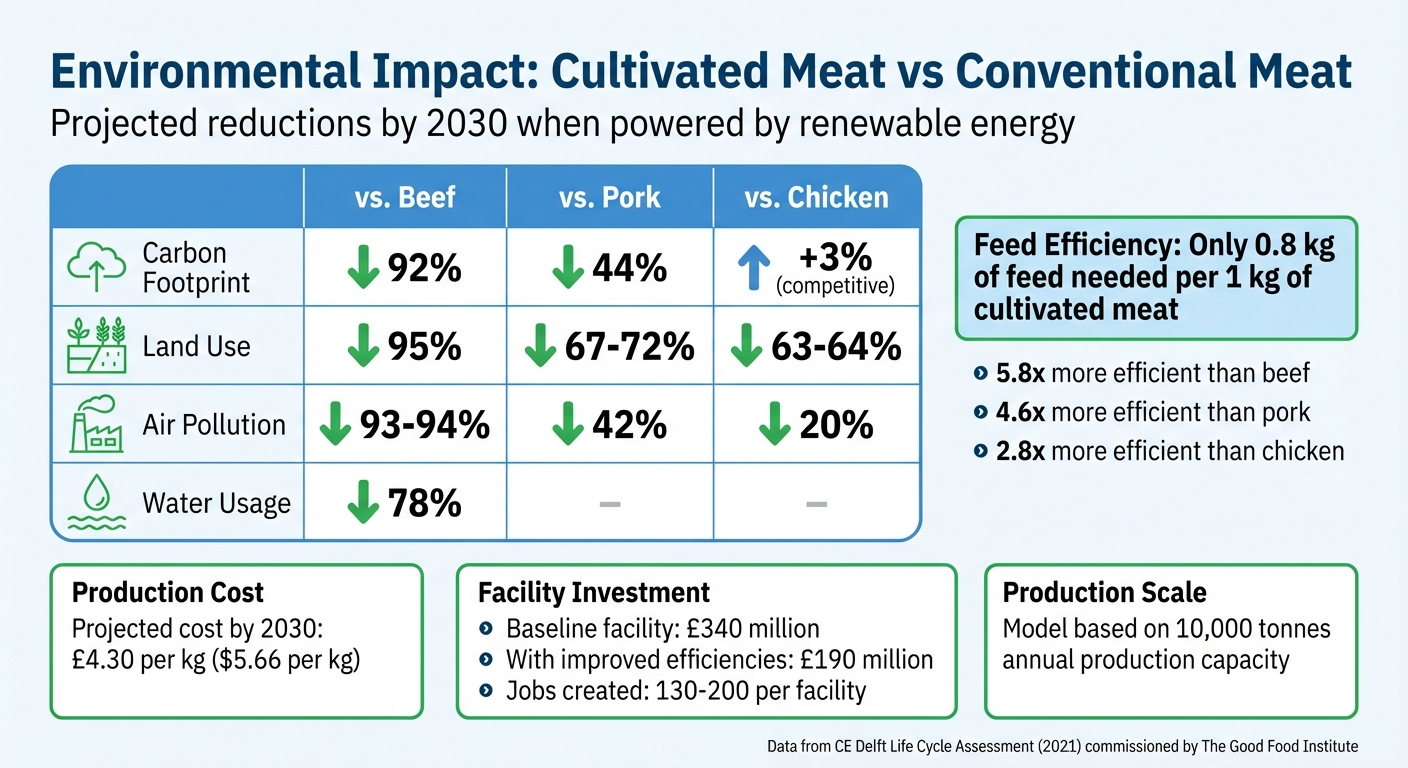
By 2030, cultivated meat powered by renewable energy could slash global warming impacts by 92% and reduce land use by 95% compared to conventional beef [16][17]. Production costs could drop to as low as £4.30 per kilogram (around $5.66 per kilogram) [16]. On top of that, air pollution might decrease by up to 94%, while water usage could be cut by 78% [16][17].
"As soon as 2030, we expect to see real progress on costs for cultivated meat and massive reductions in emissions and land use brought about by the transition to this method of meat production." - Elliot Swartz, Ph.D., Senior Scientist, The Good Food Institute [16]
Cultivated meat also stands out for its efficiency. Producing a kilogram of meat requires just 0.8 kilograms of feed, making it 5.8 times more efficient than beef, 4.6 times more efficient than pork, and 2.8 times more efficient than chicken [16][17]. The table below highlights its environmental benefits:
| Impact Category | vs. Conventional Beef | vs. Conventional Pork | vs. Conventional Chicken |
|---|---|---|---|
| Carbon Footprint | Up to 92% reduction | 44% reduction | 3% increase (competitive) |
| Land Use | Up to 95% reduction | 67%–72% reduction | 63%–64% reduction |
| Air Pollution | 93%–94% reduction | 42% reduction | 20% reduction |
Data assumes production powered by renewable energy [16][17]
Renewable energy is a cornerstone for maximising the climate benefits of cultivated meat [16]. Building a baseline commercial facility would require an estimated £340 million (approximately $450 million) in capital investment, though this cost could drop to £190 million ($250 million) with improved efficiencies [16].
"With this analysis, we show that cultivated meat presents as an achievable low‐carbon, cost‐competitive agricultural technology that can play a major role in achieving a carbon‐neutral food system." - Ingrid Odegard, Senior Researcher, CE Delft [16]
These findings underscore the potential for cultivated meat to transform both environmental and economic landscapes.
State of the Industry Reports
Beyond its environmental advantages, cultivated meat offers substantial economic and employment opportunities. GFI’s State of the Industry reports track investment levels, technological advancements, and market readiness. Recent reports indicate steady industry growth, with $226 million raised in 2023 alone, reflecting strong investor confidence [4].
These reports also highlight broader economic benefits. Large-scale production facilities could generate between 130 and 200 well-paying jobs, benefiting both urban and rural areas [17]. Additionally, the drastic reduction in land use - up to 95% compared to beef - could free up agricultural land for carbon sequestration and biodiversity initiatives, acting as a multiplier for global climate goals [16].
In the summer of 2023, the USDA approved final labelling and granted inspection for cultivated chicken products from UPSIDE Foods and GOOD Meat, marking a significant shift from research to market readiness [4]. While progress is evident, challenges remain. These include optimising cell culture media production and securing favourable financing to lower capital costs [15][16].
"The world will not get to net-zero emissions without addressing food and land, and alternative proteins are a key aspect of how we do that." - Bruce Friedrich, Executive Director, The Good Food Institute [16]
Connecting Consumers with Cultivated Meat
Scientific progress and regulatory approvals are just part of the equation - consumer trust is equally vital. The Good Food Institute (GFI) understands this challenge and focuses on bridging the gap through clear communication, consistent terminology, and support for initiatives that engage directly with consumers.
Consumer Education About Cultivated Meat
According to GFI's research, nearly 60% of people unfamiliar with cultivated meat are unwilling to try it, and even among those who are aware, 36% remain hesitant [19]. These numbers highlight the importance of providing reliable information to ease concerns and build confidence before these products enter mainstream markets.
One of GFI's key efforts has been standardising the term "cultivated meat." Research conducted in December 2022 found that "cultivated meat" resonates better with consumers compared to terms like "lab-grown" or "cell-based" [1][18]. This term is now widely adopted, with over 30 industry stakeholders across the Asia-Pacific region agreeing to use "cultivated" as the standard English descriptor [1][3][18].
To further demystify the concept, GFI has created a Cultivated Meat Image Library, offering high-quality, Creative Commons-licensed photographs. These visuals provide an accurate and appealing way to showcase the production process [1][18]. Helen Breewood, Senior Market and Consumer Insights Manager at GFI Europe, suggests:
"Companies should build familiarity by using simple metaphors to explain their production methods... Working with chefs to showcase products and highlight the sensory qualities of these foods can also help" [20].
Consumer-focused platforms like Cultivated Meat Shop complement GFI's educational initiatives by making scientific information more accessible. These platforms offer practical resources, such as product previews, waiting lists, and straightforward explanations about what cultivated meat is, how it tastes, and when it might be available. Together, these efforts transform cultivated meat from a concept into a food choice that consumers can understand and look forward to.
Education is just the first step; transparency is equally important in building trust.
Building Trust Through Clear Information
Transparency is the cornerstone of trust. GFI supports this by publishing open-access studies like Life Cycle Assessments and Techno-Economic Analyses. These reports provide detailed insights into the environmental and economic benefits of cultivated meat. For example, when produced using renewable energy, cultivated meat can slash the carbon footprint of beef by up to 92%, reduce land use by 95%, and cut water consumption by 78% [1][18].
GFI also collaborates with the FDA and USDA to ensure safety standards are met and shared with the public. Research shows that cultivated meat production results in lower microbial counts and tests negative for pathogens such as Salmonella [3]. FDA Commissioner Robert Califf has acknowledged this progress, stating:
"The world is experiencing a food revolution and the FDA is committed to supporting innovation in the food supply" [18].
Today, 174 companies dedicated to cultivated meat operate across 30 countries [4]. As this industry grows, consumer education and transparency remain crucial to ensuring these advancements translate into widespread acceptance and adoption. GFI's efforts aim to align scientific breakthroughs with public understanding, paving the way for cultivated meat to become a trusted and accessible option for all.
GFI's Vision for the Future of Food
The Good Food Institute (GFI) has a bold vision: a world where cultivated meat becomes a staple in the global food system [2]. With global meat demand expected to surge by 50% by 2050 [3], GFI sees rethinking how we produce meat as just as urgent as shifting to renewable energy.
GFI’s work centres around three key areas: open-access research, policy advocacy, and consumer education. By funding scientific studies, shaping government policies, and creating consistent terminology, GFI has laid the groundwork for cultivated meat to be widely accepted and trusted. These efforts are all part of their overarching goal - to make cultivated meat a practical and appealing part of everyday diets.
Building on successes in science and regulation, GFI is now focusing on connecting innovation with public awareness. Platforms like Cultivated Meat Shop are crucial to this goal. Acting as an educational hub, Cultivated Meat Shop helps UK consumers understand cultivated meat - what it is, how it tastes, and when it might hit the market. With features like product previews, waitlist sign-ups, and easy-to-understand explanations, it bridges the gap between scientific advancements and consumer curiosity.
Today, 174 companies across 30 countries are driving progress in the cultivated meat sector [4]. Studies show that cultivated meat could reduce beef’s carbon footprint by up to 92% [1][3], highlighting its potential to address climate challenges. GFI’s mission is to ensure these advancements lead to products that are not only innovative but also widely available and affordable. The next big step? Turning these scientific breakthroughs into everyday options for a growing global population.
FAQs
How does the Good Food Institute help make cultivated meat more affordable?
The Good Food Institute (GFI) is actively working to bring down the cost of cultivated meat. One of their main strategies is funding research focused on reducing the expense of critical elements like cell-culture media and growth-factor ingredients. They also host innovation challenges, such as the €100,000 EIT Food challenge, designed to spark new ideas and solutions for cost reduction.
Beyond funding and challenges, GFI provides in-depth cost analyses and pushes for more public and private investment to scale up production. Together, these initiatives aim to make cultivated meat more affordable and accessible for consumers in the future.
What are the environmental advantages of choosing cultivated meat?
Switching to cultivated meat comes with a host of benefits for the planet. Compared to conventional animal farming, it can slash greenhouse gas emissions by as much as 92%. This is largely because it sidesteps methane emissions from livestock and can be powered using renewable energy sources. It also requires about 90% less land, potentially freeing up vast areas for rewilding efforts or carbon capture initiatives. On top of that, it can reduce air pollution by up to 94%.
When it comes to resources, cultivated meat is much less demanding. It consumes far less water, significantly reduces water pollution, and helps curb deforestation and the resulting loss of biodiversity. By moving away from intensive livestock farming, it also decreases the risks tied to antibiotic resistance. Opting for cultivated meat is a practical step towards safeguarding ecosystems, tackling climate change, and promoting better public health.
How does the Good Food Institute (GFI) help with regulatory approval for cultivated meat?
The Good Food Institute (GFI) plays a key role in helping cultivated meat gain regulatory approval by providing technical support, funding open-access research, and promoting policy initiatives. In the United States, GFI assists companies in navigating complex regulatory pathways. They offer advice on essential safety data requirements, including cell-line characterisation, manufacturing controls, and input-material testing. Additionally, they clarify the responsibilities of the FDA and USDA-FSIS at various stages of the approval process.
In Europe, GFI works closely with governments to create clear and evidence-based frameworks for novel foods like cultivated meat. Their efforts include publishing regulatory roadmaps, sharing scientific findings, and facilitating discussions among stakeholders. These actions not only build trust but also simplify the authorisation process. GFI also invests in public research to generate the safety and nutritional data that regulators require, helping cultivated meat producers move closer to market readiness.
By combining technical expertise, research funding, and advocacy, GFI ensures cultivated meat is introduced to consumers as a safe, regulated, and responsible alternative to traditional meat.


