

If yield stays low, cultivated meat stays pricey, hard to find, and harder to make at scale. That is the main point I’d want any UK shopper to know.
When I strip the topic down, yield just means: how much edible meat comes from the inputs used. And that one number shapes almost everything a shopper cares about:
- Price: growth media can make up 50–70% of total production cost, and some estimates put marginal media cost at 55–95%
- Supply: more meat per batch means more stock can reach shops and restaurants
- Product quality: tighter process control can help keep texture, flavour, and nutrition more even from batch to batch
- Green claims: lower land, water, and energy use per kilogram only hold up if production runs well
A few figures make this clearer:
- Efficient systems in some studies use about 0.4–6.9 m² of land per kg
- Water use may be 78–96% lower than beef in some modelled cases
- Energy demand can range from 25–250 MJ per kg, so electricity source matters a lot
- In one renewable-power scenario, emissions were about 3.3 kg CO₂e per kg
- Cultivated meat is not yet approved for human retail sale in Great Britain as of 28 August 2026
What drives yield? In simple terms, I’d look at three things:
- Growth media - better formulas can cut waste and lower cost
- Bioreactors - better mixing, oxygen flow, and feeding methods can increase output
- Structuring - scaffolds and microcarriers can help turn more cell mass into food people can buy
For me, the plain-English takeaway is this: cultivated meat only starts to make sense for everyday shoppers when companies can turn the same inputs into more saleable meat. That affects price per kilogram, shelf access, and how believable the low-impact case is.
| What shoppers may care about | What yield changes |
|---|---|
| Cost | More output from the same inputs can push prices down |
| Availability | Higher batch output can help products appear in more places |
| Consistency | Better-controlled production can make batches more even |
| Land and water use | Lower use per kg is more likely when yield is high |
| Emissions | Lower figures depend on both yield and low-carbon electricity |
| UK access | Better production does not remove the need for approval |
So before I focus on headlines about lab-grown burgers or future steaks, I’d start with a simpler question: how much usable meat can producers make from each batch, and at what cost?
Cost drivers of cultivated meat production
sbb-itb-c323ed3
How Cultivated Meat Systems Increase Yield
Three design choices shape yield: growth media, bioreactor design, and the way cells are turned into the final product. When all three improve, producers get more usable Cultivated Meat from each batch. It starts with the inputs, moves through the vessel, and ends with the final structure.
Better Growth Media Means More Meat from Fewer Inputs
Growth media is the nutrient-rich liquid that feeds cells during production. It is also the biggest cost driver, making up 55–95% of marginal production cost at industrial scale [2][5]. That makes it one of the main ways to increase output per kilogram of finished meat.
The big move here is away from animal-derived inputs and towards serum-free, food-grade formulations made from plant and microbial sources. Mosa Meat reported an 88-fold reduction in the cost of its animal-free medium after optimisation [4]. That kind of drop cuts production cost and helps each batch go further. When pH, temperature, and nutrient levels are kept under close control, cells stay productive and less material is lost along the way. More of what goes in ends up as Cultivated Meat.
Once the medium is working well, attention shifts to the reactor itself.
How Bioreactor and Process Design Affect Output
The bioreactor is the controlled vessel where cells grow. Different bioreactor designs affect cell density, mixing, and oxygen delivery. If mixing is poor, some areas of the vessel slow down, and that can shrink the final harvest even when the rest of the process is running as planned.
The production mode also matters. Fed-batch systems add nutrients bit by bit, which cuts media use by around 70% while keeping yields at a similar level [3]. Continuous (perfusion) systems push this further by keeping nutrients flowing in and waste moving out while the bioreactor stays in use. These systems have reached cell densities of up to 130 million cells per millilitre over periods longer than 20 days [6]. Put simply, that means more Cultivated Meat from each litre of reactor space, along with lower costs and a steadier flow of product.
After the growth stage, the next step is structure. That decides how much of the biomass becomes food people can actually buy.
How Scaffolds and Structuring Support Usable Meat Output
Without structuring, the output is best suited to minced products such as nuggets. Whole cuts need scaffolds, which give cells a three-dimensional framework to grow and organise within.
Edible scaffolds made from materials such as alginate, cellulose, chitosan, or starch can remain in the meat. That removes the need for a separation step and cuts waste. Microcarriers also help by giving cells more surface area to attach to and grow on, which increases usable biomass in less space. Better structuring means a larger share of cell mass becomes usable Cultivated Meat. It also shapes texture and mouthfeel, which matter just as much as output when the product reaches consumers.
That higher output also lowers the resources needed per kilogram, which the next section explains.
What Higher Yield Means for Sustainability
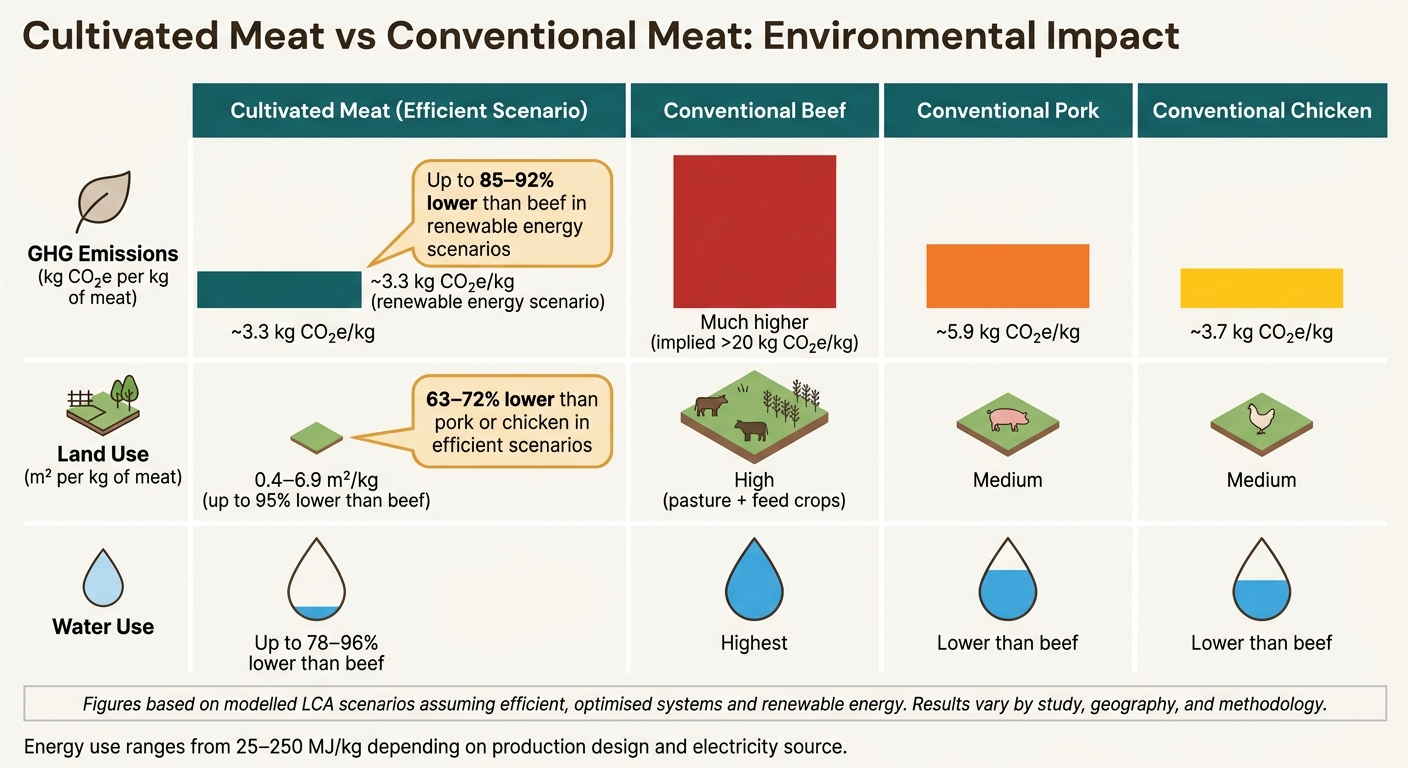
Cultivated Meat vs Conventional Meat: Environmental Impact Comparison
Higher yield does not automatically make Cultivated Meat sustainable. But it does cut the land, water and energy needed per kilogram of meat. How much it helps comes down to the production setup: the facility design, the power source and how tightly the process is run. That starts with land, water and feed.
Less Land, Water and Feed per Kilogram of Meat
LCAs keep pointing in the same direction: Cultivated Meat uses much less land than conventional meat. In modelled systems, land use comes in at around 0.4–6.9 m² per kilogram of meat.[8][17] Some studies suggest land use could drop by as much as 90–95% compared with beef, and by 63–72% compared with pork and chicken in efficient scenarios.[7][9]
The input figures tell a similar story. Cultivated Meat systems are modelled at about 0.8 kg of inputs per kilogram of meat, compared with 5.7–12.7 kg for beef, 4.6 kg for pork and 2.8 kg for chicken.[12][1] That more direct conversion means less land is needed for feed crops and livestock support. Of course, Cultivated Meat still depends on high-grade inputs like amino acids, vitamins and other media components. So higher yield is less about removing inputs and more about using them with less waste.
Water use follows the same pattern. Some LCA scenarios report 78–96% lower water use than beef per kilogram of meat when systems are optimised.[9][10] But those savings are not guaranteed. They depend on how efficiently a facility runs, how well it recycles water and media, and which crops or other inputs sit upstream.
Those savings only stick if the process stays efficient from end to end.
Energy Use and Emissions Depend on the Production Setup
This is where things get trickier. Bioreactors need tight control: a steady temperature - usually 37°C for animal cells - plus controlled pH, oxygen and mixing. Energy use is the main factor behind Cultivated Meat's carbon footprint. Higher yield helps because that energy gets spread across more edible meat.
Estimates for energy demand range from about 25–250 MJ per kilogram of meat, depending on design and scale. Perfusion systems sit at around 80–120 MJ/kg, while pilot-scale stirred-tank bioreactors can hit 150–200 MJ/kg.[13] If that energy comes from fossil fuels, emissions can climb fast. Some theoretical scenarios using highly purified growth media produced figures of 246–1,508 kg CO₂e per kilogram, which is higher than beef in those cases.[11][15][16] Those edge-case figures rely on media assumptions that are not realistic for scaled production, but they show just how much process design matters.
When production runs on renewables and the process is efficient, the picture changes sharply. One industry-based LCA found that optimised Cultivated Meat made with renewable energy can reach about 3.3 kg CO₂e per kilogram - close to the best European chicken at roughly 3.7 kg CO₂e/kg, and lower than average pork at roughly 5.9 kg CO₂e/kg.[14] Another study projects cuts of 85–92% compared with beef, 52% compared with pork and 17% compared with chicken under renewable-energy scenarios.[1] For the UK, one point stands out: cleaning up the electricity grid is central if food manufacturing - including future Cultivated Meat facilities - is to be low-carbon.
Comparison Table: Efficient Cultivated Meat Systems vs Conventional Meat
The table below sums up what efficient systems can do in modelled scenarios. It draws on LCA data, not current commercial production. All Cultivated Meat figures assume efficient, optimised systems.
| Impact Category | Cultivated Meat (efficient scenario) | Conventional Beef | Conventional Pork | Conventional Chicken |
|---|---|---|---|---|
| GHG emissions | Around 3.3 kg CO₂e/kg in one optimised renewable-energy LCA; other renewable scenarios suggest 85–92% lower than beef, 52% lower than pork and 17% lower than chicken.[14][1] | Much higher in most scenarios | Around 5.9 kg CO₂e/kg in average European systems.[14] | Around 3.7 kg CO₂e/kg in best European systems.[14] |
| Land use | Around 0.4–6.9 m²/kg; up to 95% lower than beef and 63–72% lower than pork or chicken in efficient scenarios.[8][17][7][9] | High, due to pasture and feed crops | Lower than beef, but still tied to feed crops | Lower than beef, but still tied to feed crops |
| Water use | Up to 78–96% lower than beef in optimised scenarios.[9][10] | High | Lower than beef, but savings are smaller and less certain | Lower than beef, but savings are smaller and less certain |
| Key drivers & caveats | Electricity mix, yield, media efficiency and process design shape the result; poor setups can wipe out the gains.[11][16] | Feed production, enteric fermentation, manure management and land use change | Feed production and manure management | Feed production and housing energy |
Note: These are modelled scenarios, not a promise about current products. Results vary by study, geography and methodology, and LCAs are still developing as the technology matures.
These production choices then shape price, supply and product consistency for shoppers.
What Yield Could Change for UK Shoppers
What happens in a factory doesn’t stay there. It ends up shaping what people in the UK may later see on shop shelves. In practice, higher yield mostly affects three things: price, availability and confidence in the product.
Price, Availability and Everyday Access
Higher yield cuts the cost per kilogram because the same bioreactor space and the same inputs produce more meat. Techno-economic modelling suggests production costs could fall to around $6.43 per kilogram in a hypothetical large-scale facility by 2030.[26]
That said, yield is only part of the story. UK approval will still decide when these products can actually reach shops. Cultivated Meat is not yet authorised for human retail sale in Great Britain.[28][19] The Food Standards Agency is already preparing for Cultivated Meat through its regulatory sandbox and novel food framework.[29][30] Reports suggest safety evaluations for some products could be completed around 2027, subject to ministerial sign-off.[20][22][23]
So even if production improves, shoppers probably won’t see broad supermarket access straight away. Early products are more likely to appear first in restaurants or speciality outlets, with supermarket rollout coming later.
Consistency, Safety and Clear Product Information
Price matters, of course. But if the product varies from one batch to the next, people notice fast. That’s where controlled production can make a difference. Because bioreactors regulate temperature, pH, oxygen and nutrient delivery with precision, each batch can be highly consistent in taste, nutrition, and safety. A Cultivated Meat burger bought in Manchester should be very similar to one bought in Bristol.
Safety checks also gain from that level of control. Cultivated Meat is made in closed, hygienic systems with continuous monitoring of microbial loads and batch records. If something drifts off course, producers can spot it and act fast. UK regulators treat Cultivated Meat as a product of animal origin under current food hygiene law, so it must meet the same strict standards as conventional meat, along with an extra novel food safety assessment that looks at allergenicity and nutritional quality.[18][19][21]
One point from UK evidence reviews stands out. People with an allergy to conventional meat or seafood may not be safe eating the matching Cultivated Meat product, which makes clear allergen labelling a must.[24] And because producers know the exact inputs used, detailed and accurate labels should be easier to check than with many conventional foods.
How Cultivated Meat Shop Helps Consumers Prepare
Until these products reach shelves, clear guidance gives shoppers a better sense of what to watch for. Cultivated Meat Shop explains yield, likely product formats, regulation and labelling. It also offers waitlist sign-ups and product previews, so UK shoppers can keep up with the category before launch.
Conclusion: Key Things to Remember About Cultivated Meat Yield
Yield sits at the heart of whether Cultivated Meat can work as a practical food option in the UK. Put simply, higher yield means more of the inputs end up as saleable meat, which helps cut both cost and waste impact. When production systems run well, they can also use less land and water per kilogram of meat, and emissions can fall when facilities operate on low-carbon electricity.[26][27][25]
For shoppers, that efficiency shows up in a few clear ways: price, supply and consistency. Better yields give producers a steadier path to scale and help them deliver more consistent taste, texture and nutrition. That makes Cultivated Meat easier to buy, easier to rely on and easier to fit into everyday life.
For plain-language updates, product previews and waitlist sign-ups, visit Cultivated Meat Shop.
FAQs
Why is yield so important for Cultivated Meat prices?
Yield plays a big role in Cultivated Meat pricing because it shapes how well meat is made. Put simply, higher yields mean more biomass from the same inputs - including growth media, energy, and bioreactor capacity.
That matters a lot for cost. Growth media can account for 40% to 95% of production costs, so getting more meat from each litre helps bring down the price per kilogramme. It also makes scaling more realistic, since producers can get more output without needing the same jump in resources.
What has to improve for Cultivated Meat to scale in the UK?
To scale in the UK, cultivated meat needs one thing above all: lower production costs.
A big part of that comes down to growth media. The sector needs cheaper media, better animal-component-free options, more bulk food-grade ingredients, and continuous manufacturing instead of stop-start batch production.
It also needs progress in bioreactors, automation, and stable cell lines. Those changes would help improve yields and cut the risk of batch failures.
On top of that, faster, simpler UK regulatory approval would make it easier for companies to move from lab work to commercial scale.
When could Cultivated Meat become available in Great Britain?
Cultivated Meat isn't yet on sale in Great Britain, but the sector is edging closer to launch. Commercial roll-outs are expected by 2028, while the Food Standards Agency continues to assess product safety.
By 2030, production costs are expected to drop sharply. That could make Cultivated Meat more price-competitive with conventional meat. Consumers can keep up with updates and product previews through Cultivated Meat Shop.


