

Cultivated fish does not work without stable cell lines. From what I can see, the field has made progress in species such as mackerel, grouper, goldfish and eel, but tuna still lags behind, serum use is still a big cost problem, and most products are still far from UK shop shelves.
If I had to sum up the article in plain terms, it comes down to this:
- Cell lines are the starting point for cultivated fish production
- Muscle cells shape texture, while fat cells shape flavour and mouthfeel
- Stable immortalised lines are still limited to a small number of species
- Recent results include:
- Goldfish CaMS: kept muscle-forming ability for 25 passages and produced 0.93 g of meat in 7 days
- Grouper EfADS: triglycerides increased 5.3-fold by day 15
- Mackerel Mack1: more than 130 subcultures, with doubling time cut from 63.9 hours to 24.3 hours
- Japanese eel lines: more than 120 cell doublings with fat profiles close to native eel meat
- Tuna remains a weak spot, with no stable immortalised muscle or fat lines yet
- Serum-free media and species-specific growth setups are still needed before costs can fall
- In the UK, any cultivated fish product would still need Food Standards Agency approval before sale
Here’s the short version: the science is moving, but the supply chain is not ready yet. The main jobs now are getting longer-lasting fish cell lines, cutting reliance on foetal bovine serum, and making fish that tastes and feels close to what people already buy.
SWIM: Species-specific growth factors and optimized media formulations for cultivated seafood
sbb-itb-c323ed3
Quick comparison
| Area | What matters most | Where things stand |
|---|---|---|
| Cell source | Stable lines that keep dividing | Available for some species, missing for many |
| Texture | Muscle cells and fibre formation | Some good lab results, still limited at scale |
| Flavour | Fat cells and lipid profile | Early progress in grouper and eel |
| Species coverage | Salmon, tuna, mackerel, eel, others | Uneven, with tuna still a gap |
| Growth media | Serum-free, lower-cost systems | Still a major problem |
| UK market path | Safety approval and public trust | Not ready for sale yet |
So when I look at cultivated fish today, I see a field with a clear direction: better cell lines first, then better products later.
The main fish cell types researchers are working with
Once the process is mapped, the next step is simple to ask but harder to solve: which cells can deliver texture, flavour and scale? Most research centres on three cell types: muscle for texture, fat for flavour, and stem cells for what may come next. Together, they shape the texture, flavour and structure of the final product.
Muscle cells and fillet texture
Muscle satellite cells and myoblasts are the main protein building blocks of a cultivated fish fillet. When researchers guide myoblasts to differentiate, the cells fuse into muscle fibres - the structures that give fish its familiar flake and bite. That’s the first thing most shoppers will pick up on: whether cultivated fish feels like fish when eaten.
In August 2025, researchers established the CaMS muscle stem cell line from goldfish (Carassius auratus). The line kept its muscle-forming ability over 25 passages and, with edible 3D microcarriers, produced 0.93 g of cultivated fish meat in just seven days [4].
Fat cells and their role in flavour and mouthfeel
If muscle gives cultivated fish its bite, fat gives it flavour and juiciness. Fat cells, or adipocytes, play a big part in flavour and mouthfeel in oily fish such as salmon and tuna. They store triglycerides, and phospholipids in cell membranes also add to taste.
In January 2026, researchers established the EfADS cell line, the first immortalised adipose-derived stem cell line from the brown-marbled grouper (Epinephelus fuscoguttatus). By day 15 of induction, triglyceride content had increased 5.3-fold [2]. Cultivated brown-marbled grouper fat cells showed a profile dominated by monounsaturated fat [2].
Stem cells and their potential for future product formats
Stem cells matter not just for texture and flavour, but for the kind of seafood products companies may be able to make later on. Pluripotent stem cells could help support more complex seafood formats. Since they can turn into many cell types, they give teams more options for future products.
For now, though, adult muscle stem cells are still the practical pick for most teams. They differentiate into muscle fibres more reliably, while pluripotent stem cells currently show lower muscle-formation rates [4]. That gap matters. Different species will need different cell strategies, which helps explain why the research picture is still uneven across salmon, tuna and other fish.
Recent advances in salmon, tuna and other seafood species
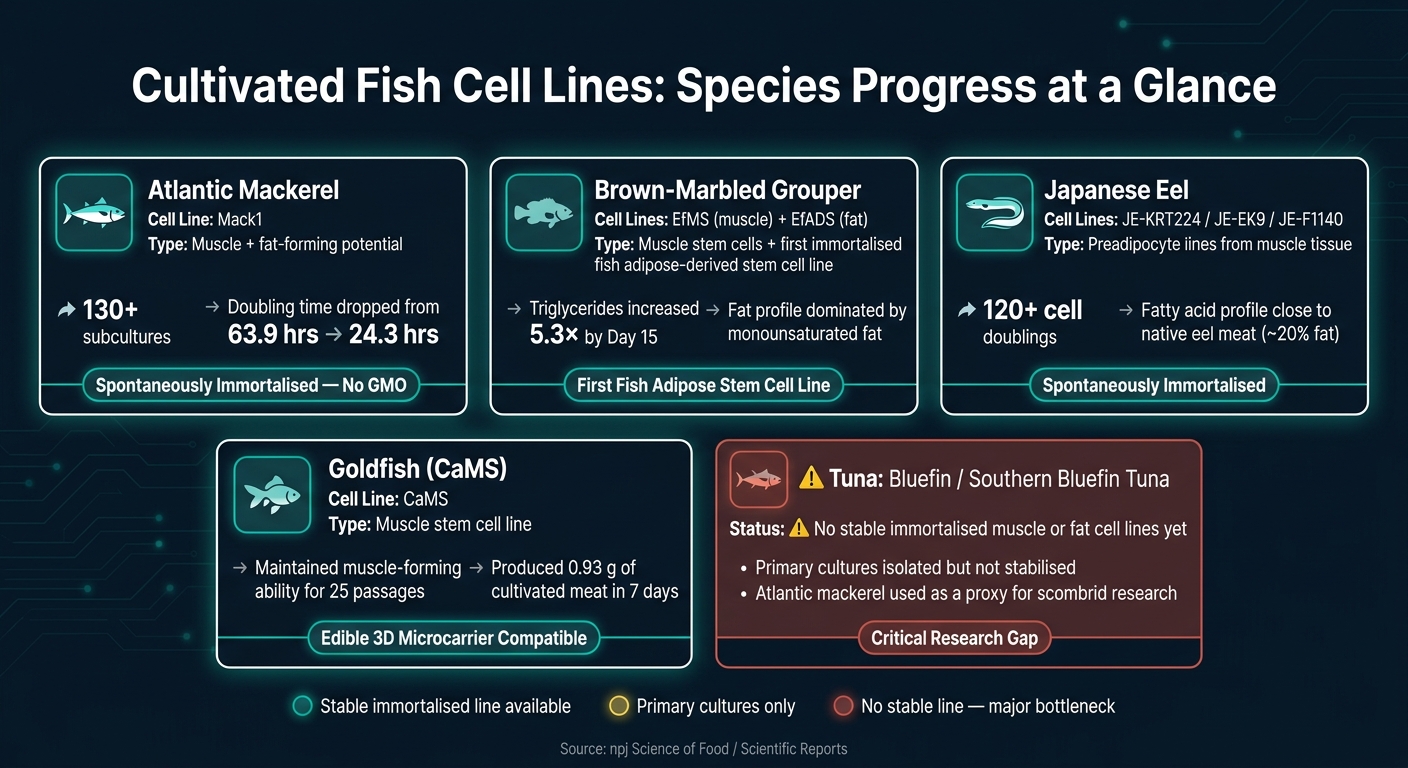
Cultivated Fish Cell Lines: Species Progress at a Glance
After cell type choice, the next bottleneck is simple to state but hard to solve: can those cells keep dividing in a steady, repeatable way? Stable cell lines are what turn a good lab result into a practical base for cultivated fish.
Progress on immortalised seafood cell lines
One of the main shifts in this area is the move away from short-lived primary cultures and towards spontaneously immortalised lines that keep dividing without genetic modification. That matters for scale-up, and it also helps with regulatory positioning in places such as Europe. So far, the clearest progress has come from a small set of species where researchers have already secured stable lines.
What studies show for mackerel, grouper and eel
Atlantic mackerel, brown-marbled grouper and Japanese eel stand out here.
In March 2023, researchers characterised the Mack1 cell line from Atlantic mackerel (Scomber scombrus). After a spontaneous immortalisation crisis between passages 37 and 43, the cells’ doubling time dropped from 63.9 hours to 24.3 hours, and the line has since been subcultured more than 130 times [5]. That means no genetic modification was needed, which makes the line easier to position under European rules. The cells also showed both muscle- and fat-forming potential. That mix is useful if you're trying to recreate mackerel’s oily texture and high omega-3 profile.
Brown-marbled grouper has moved forward too. Researchers established muscle stem cell lines, called EfMS, along with the first immortalised fish adipose-derived stem cell line, EfADS. In plain terms, that gives researchers a way to cultivate protein and fat separately, which is a big help for marbled seafood products [2][6].
Japanese eel has made progress as well. In 2025, three spontaneously immortalised preadipocyte cell lines - JE-KRT224, JE-EK9 and JE-F1140 - were established from Japanese eel muscle. These lines reached more than 120 cell doublings and developed a fatty acid profile close to native eel meat, which usually contains about 20% fat [7]. Step by step, results like these bring cultivated fish closer to the texture, flavour and fat content people already know.
| Species | Cell Line | Key Result |
|---|---|---|
| Atlantic mackerel | Mack1 | 130+ subcultures; doubling time dropped to 24.3 hours after spontaneous immortalisation [5] |
| Brown-marbled grouper | EfMS / EfADS | Muscle stem cells plus the first immortalised fish adipose-derived stem cell line; supports marbled seafood formats [2][6] |
| Japanese eel | JE-KRT224 / JE-EK9 / JE-F1140 | 120+ cell doublings; fatty acid profile close to native eel meat [7] |
Why tuna cell lines are still a gap in the research
Tuna shows where the field still runs into a wall. Some of the most important commercial species are still difficult to stabilise. Primary cultures have been isolated for species such as southern bluefin tuna (Thunnus maccoyii), but stable, immortalised muscle and fat cell lines are still missing [5][7].
That gap has forced researchers to use Atlantic mackerel as a proxy when studying scombrid muscle biology, which says a lot about how few tuna-specific tools are available [5]. It's a bit like trying to build a car with parts borrowed from a different model: you can learn something, but only up to a point.
"The lack of immortalized fat cell lines is a significant bottleneck for cultured seafood production." - npj Science of Food [7]
There are also very few species-specific research tools, including the muscle markers needed to confirm that cultivated tuna cells have differentiated as expected [5]. Without those markers, checking tuna cell identity remains difficult.
What scientists still need to solve before cultivated fish reaches shoppers
The need for longer-lasting fish cell lines
Even with progress by species, the same big problems keep showing up: stable cell lines, lower-cost media and fish that feels like fish when you eat it.
Right now, most cultivated fish work still begins with primary cells - cells taken straight from fish tissue. The trouble is, these cells don't last long. They can age fast or stop dividing, which makes them a poor fit for steady, large-scale production. In plain terms, researchers may need new biopsies for new batches. That adds variation and pushes up costs.
The long-term fix is immortalised cell lines. These are cells that have made it through a spontaneous immortalisation crisis, where most cells stop dividing and only a small number adjust and keep growing, without genetic modification. But this doesn't happen on command. It's hard to predict, and so far it has only been done for a small number of species.
"In Cultivated Meat, immortalised cells are essential for consistency during large-scale production." - Scientific Reports [1]
Without stable, immortalised lines for more species, supply will stay tight and prices will stay high. That's why work on salmon, tuna and other fish still matters so much.
Serum-free growth media and fish-specific culture conditions
A stable cell line solves only part of the problem. You still need to grow those cells in a reliable, lower-cost way.
Fish cells often grow at 18–22°C in species-specific media such as Leibovitz's L-15, but most studies still depend on foetal bovine serum (FBS), sometimes at levels as high as 20% [1]. That's a major sticking point. FBS is expensive, inconsistent and ethically problematic, so it's not a good fit for a product meant for everyday shoppers.
Researchers need serum-free, animal-component-free media if they want to bring costs down [8][9][10]. And here's the catch: each species may need its own fine-tuned setup. Until that happens, scaling production will stay slow.
Current research challenges versus future consumer benefits
The table below shows how the main lab problems show up at the shop shelf. It's a direct link: what slows scientists down today can shape price, taste and availability for shoppers tomorrow.
| Research Bottleneck | What It Affects for Shoppers |
|---|---|
| No stable cell lines | Inconsistent supply and higher retail prices |
| Serum dependence | High production costs passed on to consumers |
| Slow growth | Limited availability and slower production cycles |
| Weak flavour and mouthfeel | Weaker flavour and mouthfeel |
| Poor texture | Mushy or unstructured texture rather than a firm fillet |
For UK shoppers, these limits will shape whether cultivated fish is affordable, easy to find and recognisably fish-like.
What this means for cultivated fish in the UK
How cell line progress could shape future products
These lab advances matter only if they turn into products UK shoppers can recognise and trust. Right now, most work is aimed at minced or blended products. But stronger cell lines could also help make structured fillets by combining muscle and fat cells [1][7].
Texture is a big part of that. So is safety. And so is where the product comes from. Cultivated fish may also avoid contaminants found in wild-caught seafood, including mercury and microplastics [1][8].
For UK and European markets, spontaneously immortalised cell lines have a clear appeal because they avoid GMO rules [1].
Why consumer education matters before cultivated fish arrives
That means public education needs to be part of the rollout from the start, not something added later. Before any cultivated fish product can be sold in the UK, it must pass a rigorous safety assessment by the Food Standards Agency (FSA) as a novel food [8][3].
Before products reach shelves, shoppers need a clear explanation of the science. Cultivated Meat Shop explains cell lines in plain English and why they matter for taste, texture and availability.
Conclusion: key takeaways from current seafood cell line research
Seafood cell lines are the foundation of cultivated fish. Without stable, scalable lines, there is no consistent product or reliable supply. Progress is happening, but each step in cell line stability and multi-cell-type culture still has to close the gap between the lab and commercial scale.
For UK shoppers, the main point is simple: progress is happening, but products are still some way from scale and approval.
FAQs
Why are stable cell lines important?
Stable cell lines matter a great deal for Cultivated Meat. They give producers a steady, scalable supply of cells, which makes production far more consistent. Without them, researchers have to keep collecting new cells from adult tissue. That adds cost, slows work down, and makes the whole process less efficient.
They also make long-term cultivation much easier. Because the cells grow in a more predictable way, teams can produce muscle and fat tissue with clearer, more controlled traits. In plain terms, that helps companies make high-quality products at a lower cost.
Why is tuna harder than mackerel or eel?
The sources don’t directly compare tuna with mackerel or eel. Even so, one point is clear: building stable, continuous cell lines for seafood is hard work.
A big reason is simple. Researchers often don’t have species-specific protocols to work from. So instead of following a well-tested playbook, they’re often piecing one together as they go.
The main sticking points include:
- finding suitable cell lines
- making specialised growth media
- developing techniques that can scale
- dealing with differences in cell sensitivity and behaviour between species
That last point matters more than it might seem. Cells from one species can react very differently from those of another, which makes it tough to apply the same method across tuna, mackerel, eel, or other seafood species.
What still blocks cultivated fish from UK shops?
Cultivated fish still faces a few big sticking points: reliable, standardised cell lines for different species, scaling production in large bioreactors, and the high cost of sustainable growth media and growth factors.
There’s another side to this too. Before these products can appear in UK shops, the sector also has to deal with consumer concerns, along with ethical and safety questions.
For people who want to follow what’s happening without getting lost in the jargon, Cultivated Meat Shop helps explain these developments for curious consumers.


