

If you want precise control, cultivated meat looks stronger on paper. If you want something you can buy now in the UK, conventional meat still wins.
As of 30 June 2026, cultivated meat is not on sale in the UK. So the comparison is simple: conventional meat gives you choice today, while cultivated meat could give you tighter control later over fat profile, protein levels, iron, zinc, vitamin B12, texture, and production inputs.
Here’s the short version:
- Fat and calories: cultivated meat may let producers set lower saturated fat and a steadier fat-to-protein ratio
- Nutrients: iron, zinc, and B12 may be more consistent from batch to batch
- Safety and inputs: closed production may cut the risk of E. coli and Salmonella and avoid routine antibiotics
- What you can control now: with conventional meat, you’re still limited to cut, species, mince fat %, and trimming visible fat
- Current downside: cultivated meat is still in development, and early samples have shown trade-offs, including lower protein in at least one study
Lab-grown meat vs. traditional chicken: how do they compare?
sbb-itb-c323ed3
Quick Comparison
| Area | Cultivated Meat | Conventional Meat |
|---|---|---|
| UK availability | Not yet on sale | Sold across UK shops |
| Fat profile | Can be adjusted during production | Mostly set by cut, species, and marbling |
| Protein/fat ratio | Can be set more closely | Varies by animal and cut |
| Iron, zinc, B12 | May be standardised | Naturally present but variable |
| Texture and flavour | Still being worked on | Already familiar to shoppers |
| Antibiotic use | No routine antibiotics in closed production | Depends on farming system |
| Food safety control | Lower contamination risk in closed systems | Higher exposure during slaughter and handling |
| Product formats | Early focus likely on mince or blended forms | Full range of cuts and formats |
My takeaway: this is less about a cultivated vs traditional meat health comparison and more about where control sits. With conventional meat, the animal sets most of the limits. With cultivated meat, the producer may be able to shape the end product much more closely.
That’s the core difference this article explains.
How Cultivated Meat can be shaped for health and dietary goals
Cultivated Meat can be adjusted through the culture medium and the mix of cells, which gives producers tighter control over fat, protein and micronutrients. Some of these methods are still being worked on.
Controlling fat and protein
The nutrition profile of Cultivated Meat is shaped mainly through the culture medium - the nutrient-rich liquid that cells grow in [1][3]. Change the lipid mix in that medium, and producers can shift the balance between saturated and polyunsaturated fatty acids in the final product [1][3]. They can also grow fat and muscle cells together on a porous scaffold, giving them close control over marbling and the fat-to-protein ratio [3].
That opens the door to products aimed at heart health, with less saturated fat, more unsaturated fat, and possibly more omega-3s. For shoppers trying to manage fat, protein and micronutrient intake, that level of control could make a big difference.
Adding or standardising nutrients
Because production takes place in a controlled setting, it may be possible to make meat with predictable levels of iron, zinc and vitamin B12 from batch to batch - something that can vary in conventional meat depending on breed, feed and age [1]. If someone tracks what they eat closely, that kind of consistency makes dietary targets easier to hit.
Some research models have found cultivated chicken to contain higher levels of several minerals and vitamins than conventional chicken [2]. These findings are still early-stage, but they suggest Cultivated Meat could become a more nutritionally consistent option.
Nutrition isn't the whole story. Texture and flavour matter too, especially if a product is meant for day-to-day meals.
Adjusting texture, flavour and ingredient mix
Early Cultivated Meat showed that texture depends heavily on fat cells, which is why growing fat and muscle cells together matters [4]. Flavour is being worked on as well, including cooking-activated scaffolds that release aromatic compounds only at cooking temperatures, in a way that mimics the Maillard reaction in conventional meat [4].
On the ingredient side, production in sterile, closed bioreactors means routine antibiotics are not needed. That same closed, sterile process also lowers contamination risk from pathogens such as E. coli or Salmonella [1][2].
That matters because conventional meat still gives people plenty of choice, but not this sort of precision.
Where traditional meat offers choice and where it falls short
Traditional meat gives shoppers some control, but not enough to shape the nutrition profile in a precise way. In the UK, people can make choices that affect what ends up on the plate, but those choices work at a broad level, not a fine-tuned one.
What shoppers can already control
The most practical tools today are cut selection, species choice, and fat trimming. Choosing leaner cuts, trimming visible fat, or picking 5% fat mince instead of 20% fat mince can all change calorie and fat intake. Shoppers can also choose between ground or processed meat and whole-muscle cuts. Feed can shift some nutrient levels, especially omega-3s, but not with precision.[1]
That gap matters most when someone wants a specific fat profile or a set nutrient target.
The limits of precise nutrition changes
Those broad choices do not add up to nutritional design. The main limit is simple: traditional meat is shaped by the animal, not by the shopper. This contrasts with how cultivated meat is made, where the process is controlled from the start. Nutrients build up over the animal’s lifetime through diet and metabolism, so levels vary by species, cut, feed, and age. It still provides heme iron, zinc, vitamin B12, and all nine essential amino acids, but the amounts differ.[1]
That makes exact targets, such as a fixed B12 or omega-3 level per portion, hard to guarantee.[1]
Cultivated Meat vs traditional meat: a comparison by dietary need
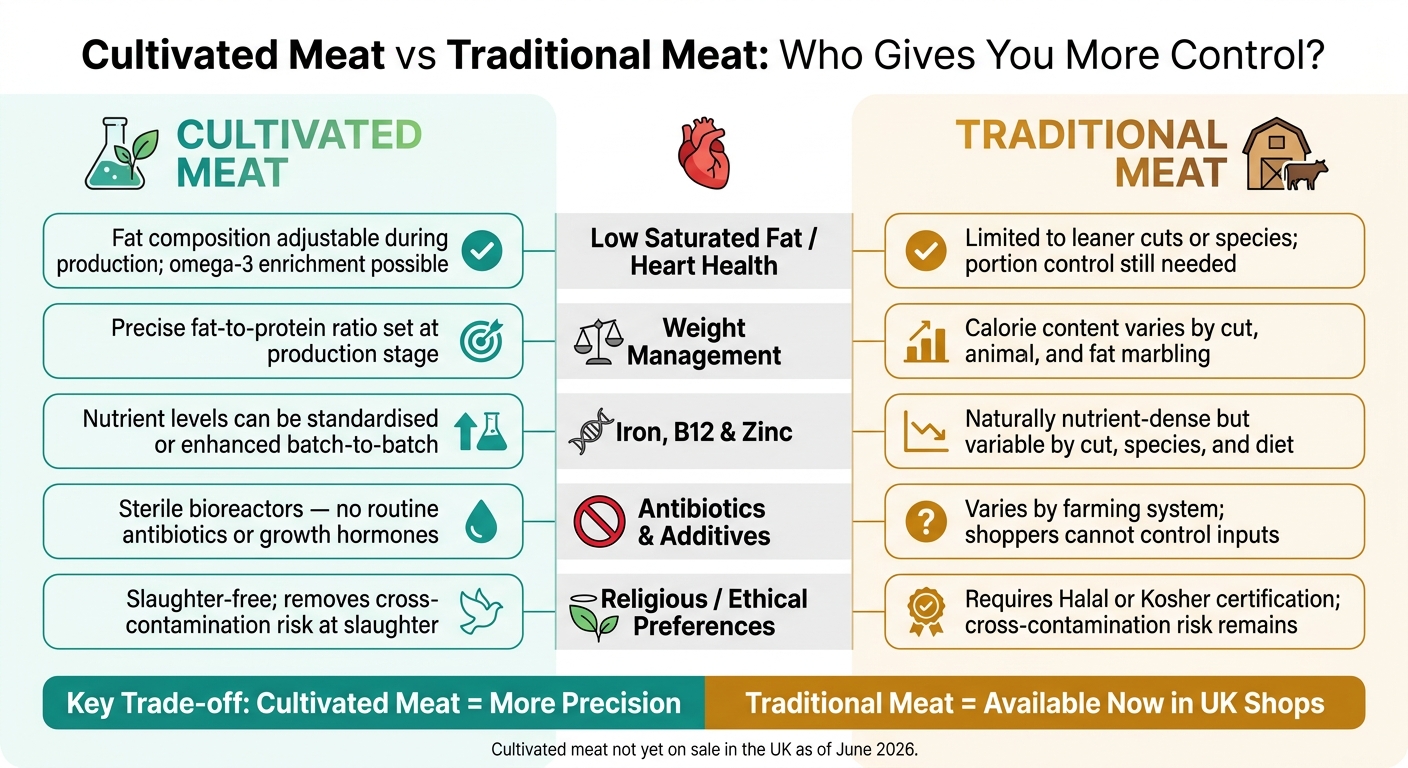
Cultivated Meat vs Traditional Meat: Nutrition & Control Comparison
The clearest way to compare these two options is through dietary need. For UK shoppers, that usually comes down to a few plain questions: Which one gives better fat control? Which one keeps nutrients more consistent? And which one gives tighter control over ingredients?
The table below sets Cultivated Meat and traditional meat side by side across the dietary needs that matter most. It also shows where Cultivated Meat may allow more exact tailoring later on, and where traditional meat is still the easier, more practical pick right now[1].
| Dietary Need | Cultivated Meat Possibilities | Traditional Meat Options & Limits |
|---|---|---|
| Low-saturated-fat / heart health | Ability to adjust fat composition and enrich tissue with omega-3 fatty acids[1][2] | Limited to choosing leaner cuts or species; portion control is still needed[1] |
| Weight management | Precise control over fat-to-protein ratios during production[1] | Calorie content varies by cut, animal, and fat marbling[1] |
| High iron / B12 / zinc needs | Nutrient levels can be standardised or enhanced across every batch[1][2] | Naturally nutrient-dense but variable by cut, species, and animal diet[1] |
| Lower antibiotics and additives | Produced in sterile bioreactors without routine antibiotics or added growth hormones[1] | Varies by farming method, so shoppers cannot fine-tune these inputs[1] |
| Religious and ethical preferences | Slaughter-free production; removes cross-contamination risks from slaughter[1] | Requires Halal or Kosher certification; cross-contamination risk remains[1] |
The biggest day-to-day differences come down to fat control, nutrient consistency, and ingredient control.
Heart health, fat profile and calorie control
For people keeping an eye on cardiovascular health, fat control is where the gap is easiest to see. With Cultivated Meat, producers aim to shape the fat profile during production itself[1][2]. In practice, that could mean less saturated fat, more unsaturated fat, and a calorie profile that stays more consistent from pack to pack.
Conventional meat doesn't offer that same level of control today. If you're buying beef, lamb, chicken, or pork, fat content can shift quite a bit depending on the cut and marbling. So for calorie control, the difference is pretty simple: Cultivated Meat could be made to keep the fat-to-protein ratio steady across every batch, rather than leaving shoppers to work around natural variation[1].
Iron, B12, zinc and more predictable nutrition
Traditional meat is naturally rich in heme iron, zinc, and vitamin B12. But those levels are not fixed. They can change based on the animal's age, diet, and the cut you buy[1].
That is where Cultivated Meat gets interesting. Research found that one cultivated chicken sample had higher levels of calcium, iron, and zinc than its conventional equivalent[2]. But there is a catch. The same study also found lower protein content and lower amounts of most essential amino acids in that sample[2].
So the picture isn't one-sided. There is clear room to tune nutrient levels, but the work is still in progress.
Additives, contaminants and dietary fit
Cultivated Meat is produced in closed, sterile bioreactors, which gives manufacturers tighter control over ingredients[1][2]. For shoppers who want fewer unknowns in the production process, that matters.
There is also a format issue. Early products are likely to show up as minced or blended options, while whole cuts are still being developed[1]. Traditional meat still has the edge on choice in UK shops today, simply because it comes in the full range of cuts and formats people already know.
Conclusion: Which type of meat gives consumers more flexibility?
When you compare cultivated vs traditional meat, the answer is pretty simple. Right now, traditional meat has the practical edge because it’s already sold widely in UK shops.
When it comes to dietary control, traditional meat gives people options, but not exact control. The limits come from the animal itself: shoppers can pick a leaner cut, yet they can’t precisely set the fat profile or nutrient levels.
That’s where Cultivated Meat stands apart. Its main advantage is precision. Producers can shape fat composition and standardise nutrients at the cellular level.
For now, Cultivated Meat is not yet on sale in the UK. Cultivated Meat Shop tracks its progress for curious shoppers.
FAQs
How could Cultivated Meat be tailored for specific diets?
Cultivated Meat can be shaped to suit specific diets by adjusting its nutritional profile during production. By changing the growth medium and cell culture conditions, producers can increase helpful components like omega-3 fatty acids and cut less desirable elements such as saturated fats.
It can also be fortified with vitamins, minerals and amino acids to meet different nutritional needs.
Why might Cultivated Meat have more consistent nutrients than traditional meat?
Cultivated Meat may offer more consistent nutrients because it’s made in a controlled setting. That helps cut the natural variation you often get from animal stress, changes in diet, and handling.
Traditional meat can vary from one animal to another. Cultivated Meat, by contrast, gives producers tighter control over growth conditions, which can help each batch keep a more consistent nutritional profile.
What are the main trade-offs of Cultivated Meat so far?
Cultivated meat comes with some clear upsides, including customisable fat profiles and less antibiotic use. That said, there are trade-offs too.
This is still an early-stage category, so researchers are still studying the long-term health effects. That matters. New food formats often look promising at first, but the bigger picture only becomes clear with time and more data.
There are also product-level challenges. Early versions may not yet match the texture, structure, and overall complexity of traditional cuts. On top of that, the industry is still working through a few hard problems:
- nutrient bioavailability
- protein content
- scaling production so prices become more affordable
So while the idea is moving forward, some of the basics people care about most, like nutrition, eating quality, and cost, are still being worked on.


