

If cultivated meat runs on fossil power, its carbon output can stay high. If it runs on renewables, the picture changes fast.
I’d sum it up like this: cultivated meat uses far less land and water than beef, but its climate impact depends mostly on electricity and heat. The biggest energy loads are cooling, bioreactors, sterilisation, and cleaning. Studies in the article point to cuts of 64–67% in overall impact with cleaner power and process changes, and up to 85–92% lower global warming impact than beef when renewable energy is used.
Here’s the short version:
- Energy is the main issue. Cultivated meat needs power and heat all day, every day.
- Cooling is a major load. It can account for 45–70% of site energy use.
- Clean electricity matters most. A fossil-heavy grid can wipe out much of the climate case.
- Heat matters too. Sterilisation, hot water, and cleaning need low-carbon heat, not just green power.
- Best-fit options in the UK include renewable PPAs, solar PV, wind, heat pumps, solar thermal, batteries, and thermal storage.
- For UK buyers, cost matters. Lower long-term energy costs could help bring prices down as production scales.
A quick comparison makes the point clear:
| Option | Emissions | Land use | Water use | Main issue |
|---|---|---|---|---|
| Cultivated meat on fossil grid | High | Low | Low | Energy source drives CO2 output |
| Cultivated meat on renewables | Low | Low | Low | Clean power and heat cut emissions hard |
| Conventional beef | Highest | Highest | High | Methane and feed system |
So, if you want the simple answer: cultivated meat is only as low-carbon as the energy behind it. In the UK, a cleaner grid and on-site renewable supply could make a big difference to both emissions and future cost.
Valeti on the environmental benefits of cell-cultivated meat
sbb-itb-c323ed3
Where Energy Is Used in Cultivated Meat Production
Cultivated Meat production depends on tightly controlled biological conditions 24/7. That means plants use both electricity and heat all the time. In simple terms, electricity keeps the system running, while heat does the heavy lifting for cleaning and sterilisation.
Electricity for Growing, Mixing and Cooling
Bioreactors sit at the centre of Cultivated Meat production. If the cells are going to stay alive and keep multiplying, the bioreactor has to hold a steady 37°C - roughly body temperature. At the same time, mixing systems, pumps that move growth media, and monitoring equipment all draw electricity continuously [4].
Cooling is one of the biggest energy drains in the whole process. As bioreactors get larger, heat builds up inside them and has to be removed by active cooling. In many cases, cooling makes up 45-70% of a facility's total energy use [4]. That's a big deal, because grid electricity can end up being one of the main sources of the plant's carbon footprint.
The energy demand doesn't stop once cultivation ends. Food safety rules also require the product to be cooled fast, dropping from 54°C to 4°C within seven hours [4].
Heat for Sterilisation, Cleaning and Hot Water
Electricity is only one side of the story. Producing food-safe Cultivated Meat also needs steady, high-temperature heat. After each batch, bioreactors must go through steam sterilisation, known as sterilisation-in-place (SIP), so the system stays free from contamination.
Plants also need hot water for cleaning-in-place (CIP). This process flushes and sanitises pipework and vessels without taking them apart. Put plainly, renewable electricity on its own doesn't cover the whole job. Heat demand matters too, which is why the energy source has such a big effect on emissions.
How Renewable Energy Changes the Carbon Footprint
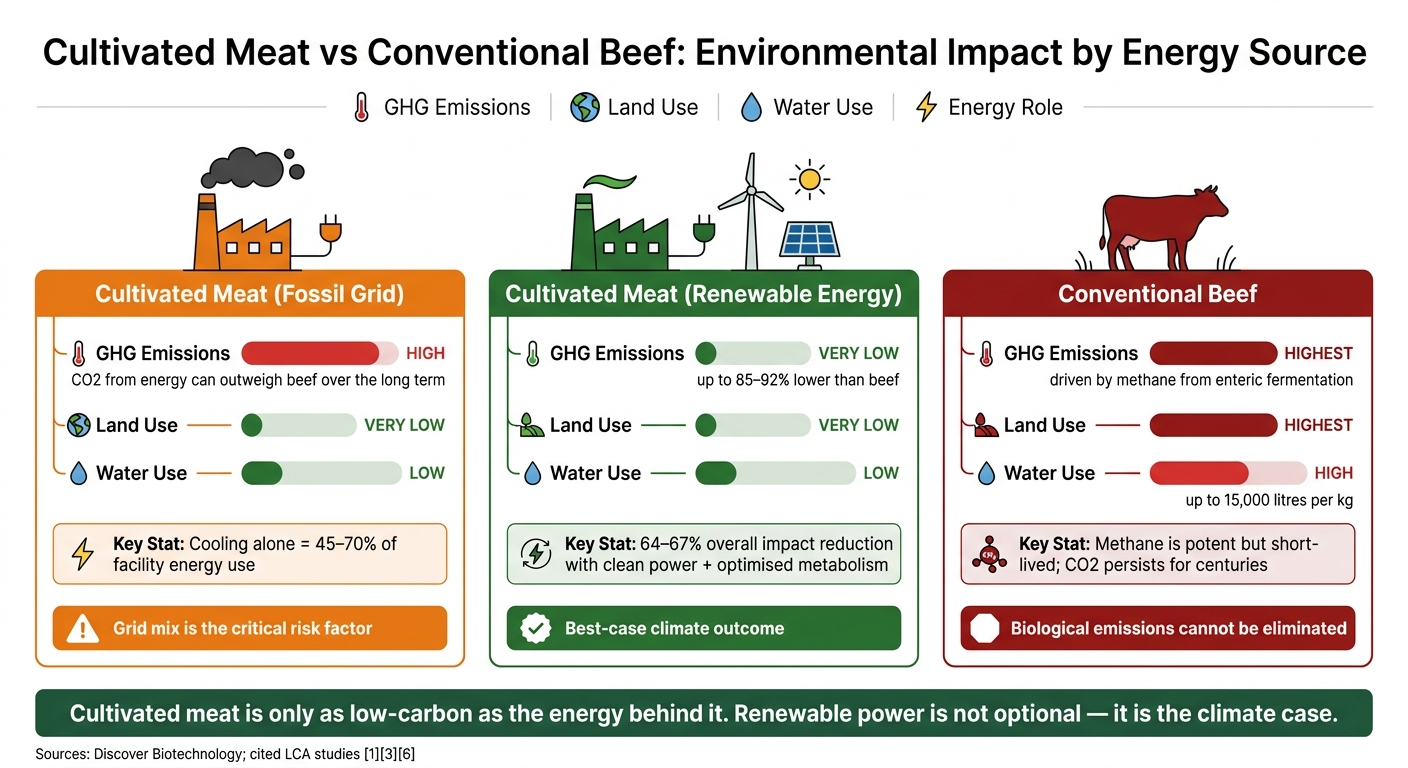
Cultivated Meat vs Conventional Beef: Environmental Impact by Energy Source
Cultivated Meat facilities don't switch on for a few hours and then go quiet. They run all the time. That means electricity and heat can make or break the carbon footprint, and the electricity mix becomes the single biggest factor.
Why the Electricity Grid Has Such a Large Effect
Bioreactors, cooling systems, and sterilisation need a steady flow of energy. So the carbon intensity of the grid goes straight into the footprint of the final product. If that power comes from a fossil-heavy grid, the CO2 linked to energy use can stay in the atmosphere for centuries. That weakens the climate argument for Cultivated Meat.
This is where things get tricky. Conventional beef produces large amounts of methane, which is a powerful greenhouse gas but doesn't last as long. Cultivated Meat, by contrast, is tied more closely to CO2 from energy use. CO2 is less potent in the short term, but it hangs around much longer. So if the grid stays fossil-heavy, the long-term climate case for Cultivated Meat gets much weaker. Move production onto renewable power, and the picture changes a lot. Research suggests that pairing renewable energy with optimised cell metabolism can cut the overall environmental impact by 64–67% [5].
How Cultivated Meat Compares with Conventional Meat
The comparison comes down mostly to the electricity mix. Land and water savings stay large either way, but emissions can swing sharply depending on how the facility is powered.
| Product Type | Greenhouse Gas Emissions | Land Use | Water Use | Role of Energy |
|---|---|---|---|---|
| Cultivated Meat (Fossil Grid) | High; CO2 from energy use can outweigh beef over the long term [3] | Very low | Low | Main source of footprint; fossil electricity drives high CO2 output |
| Cultivated Meat (Renewable) | Very low; low-carbon power can reduce impact by 64–67% [5] | Very low | Low | Key to making the product low-carbon |
| Beef (Conventional) | Highest; driven by methane from enteric fermentation [3] | Highest | High; up to 15,000 litres per kg [3] | Biological and feed-based |
Renewable electricity keeps the land and water edge in place. But emissions are a different story. Without clean power, early life cycle assessments found that the heavy energy demand from bioreactors and refined growth media could push Cultivated Meat's carbon footprint above conventional beef [3]. That's a sobering result, and it shows why the shift in energy supply isn't optional for this sector.
"Cultivated meat production, if highly refined growth media are used, could have a significantly greater environmental impact than conventional beef production." - Discover Biotechnology [3]
As processes improve and grids decarbonise, the emissions case for Cultivated Meat gets stronger. The next section looks at the renewable options that can deliver that shift.
Renewable Energy Options for Cultivated Meat Facilities
Clean power can lower emissions and trim running costs. For most Cultivated Meat facilities, that usually means a mix of renewable grid power, on-site generation, and lower-carbon heat.
Renewable Electricity: Grid Supply, Solar and Wind
For many UK facilities, a renewable electricity contract or Power Purchase Agreement (PPA) is a sensible place to start. It gives you a steady supply of clean electricity and can help smooth long-term energy costs [4]. In a sector where bioreactors run around the clock, that kind of cost certainty matters just as much as the emissions cut.
On-site solar PV is a good fit for facilities with spare roof space or nearby land. It can lower daytime electricity costs straight away and works well with battery storage, especially where cooling demand stays steady through the day. Wind power tends to suit larger plants or sites with reliable wind, where it can support the heavy electricity needs of cooling and ventilation systems.
The best setup often combines on-site generation with a renewable grid contract. That way, facilities are not relying on a single source, and energy choices affect operating costs as well as emissions.
Low-Carbon Heat and Storage: Heat Pumps, Solar Thermal and Batteries
Electricity is only part of the picture. Sterilisation, cleaning, and hot water all need heat. Industrial heat pumps offer a direct route away from gas-fired heating by using lower-emissions electric heat. Solar thermal panels can pre-heat water for cleaning and sanitation, which cuts the load on heat pumps or boilers.
There is also the issue of timing. Solar and wind output can rise and fall, while facility demand stays fairly constant. That’s where storage helps. Batteries balance electricity supply in real time, while thermal storage can shift cooling loads to off-peak periods, when renewable generation is higher or electricity is cheaper [4]. Heat recovery adds another layer by reusing waste heat from bioreactors for cleaning and sterilisation.
Heat decarbonisation matters just as much as clean electricity when you look at overall facility performance.
| Energy Type | Typical Use in Cultivated Meat Production | Energy Form | Potential Emissions Benefit |
|---|---|---|---|
| Solar PV | Daytime electricity for mixing and ventilation | Electricity | High |
| Wind Power | High-load refrigeration and processing | Electricity | High |
| Green Grid / PPA | Reliable renewable electricity supply | Electricity | High |
| Industrial Heat Pumps | Sterilisation, hot water, climate control | Heat / Cooling | High (replaces gas boilers) |
| Solar Thermal | Pre-heating water for cleaning and sanitation | Heat | Moderate to High |
| Battery Storage | Balancing intermittent solar/wind with constant demand | Electricity | High (optimises renewable use) |
| Thermal Storage | Shifting cooling loads to off-peak hours | Heat / Cooling | Medium (reduces peak demand) |
What Renewable Energy Means for UK Consumers and the Future of Cultivated Meat
How Energy Costs Could Affect Future Price and Availability
Because these facilities run all the time, energy costs feed straight into future pricing. Energy is one of Cultivated Meat's biggest operating costs[1]. As the UK grid decarbonises, both costs and emissions come down[1].
That link matters. If electricity gets cleaner and more stable in price, producers have a better shot at making Cultivated Meat more affordable over time.
Long-term renewable contracts and on-site generation can help steady costs as production scales[6]. Some developers are also testing farm-scale systems powered by local solar, wind or biogas[2]. In the UK, that idea may have room to grow. A Royal Agricultural University report suggests openness among farmers to decentralised Cultivated Meat production[2].
If that model takes hold, it could help bring production costs down gradually as the technology matures. Lower operating costs also make the long-term business case stronger.
Conclusion: Cleaner Energy Strengthens the Case for Cultivated Meat
This is the main climate edge. Conventional livestock will always produce methane as a biological byproduct, while Cultivated Meat's energy-related emissions can fall as the grid decarbonises[1].
With renewable electricity, Cultivated Meat could reduce global warming impact by 85–92% compared with beef, 52% compared with pork, and 17% compared with chicken[1]. The UK's growing share of wind and solar makes that outcome more realistic[1].
FAQs
Why does Cultivated Meat use so much energy?
Cultivated Meat production uses a lot of energy for a pretty simple reason: cells need precise temperatures inside bioreactors if they're going to grow as planned. On top of that, making nutrient-rich culture media takes a lot of power too.
Then there's the scale problem. Bigger systems need a steady supply of electricity for agitation, aeration, and monitoring, so energy use doesn't just come from one part of the process.
As Cultivated Meat Shop notes, renewable energy and production optimisation will matter if producers want to bring those demands down.
Is renewable electricity enough on its own?
Renewable energy plays a big part in cutting the environmental footprint of Cultivated Meat. But on its own, it often isn’t practical. The reason is simple: sources like wind and solar don’t produce power at a steady rate all the time.
Cultivated Meat production, by contrast, needs a constant and reliable power supply. Even short dips in electricity can disrupt operations. That’s why facilities usually don’t rely on renewables alone. Instead, they tend to pair renewable electricity with grid power, battery storage, or backup power systems so production stays steady and costs stay under control.
Could renewable energy make Cultivated Meat cheaper?
Yes. Renewable energy could help make Cultivated Meat more affordable and less resource-heavy, because current production uses a lot of power.
Right now, up to 95% of costs are tied to energy, mainly for bioreactors and growth media. That means electricity prices can have a huge effect on the final cost of production.
If producers switch to renewable power, they may be able to steady long-term costs and reduce pressure from energy price swings. That could also support efforts to bring production below £8 per kilogram.


